
Website Services
How to Optimize Dentists Website Services for High-ROI Acquisition
Turn your dental practice website into a patient acquisition engine with clear user mapping, automated lead cascades, and conversion-focused architecture.
8 min read
Website Services
 By Kayce Marty7 min read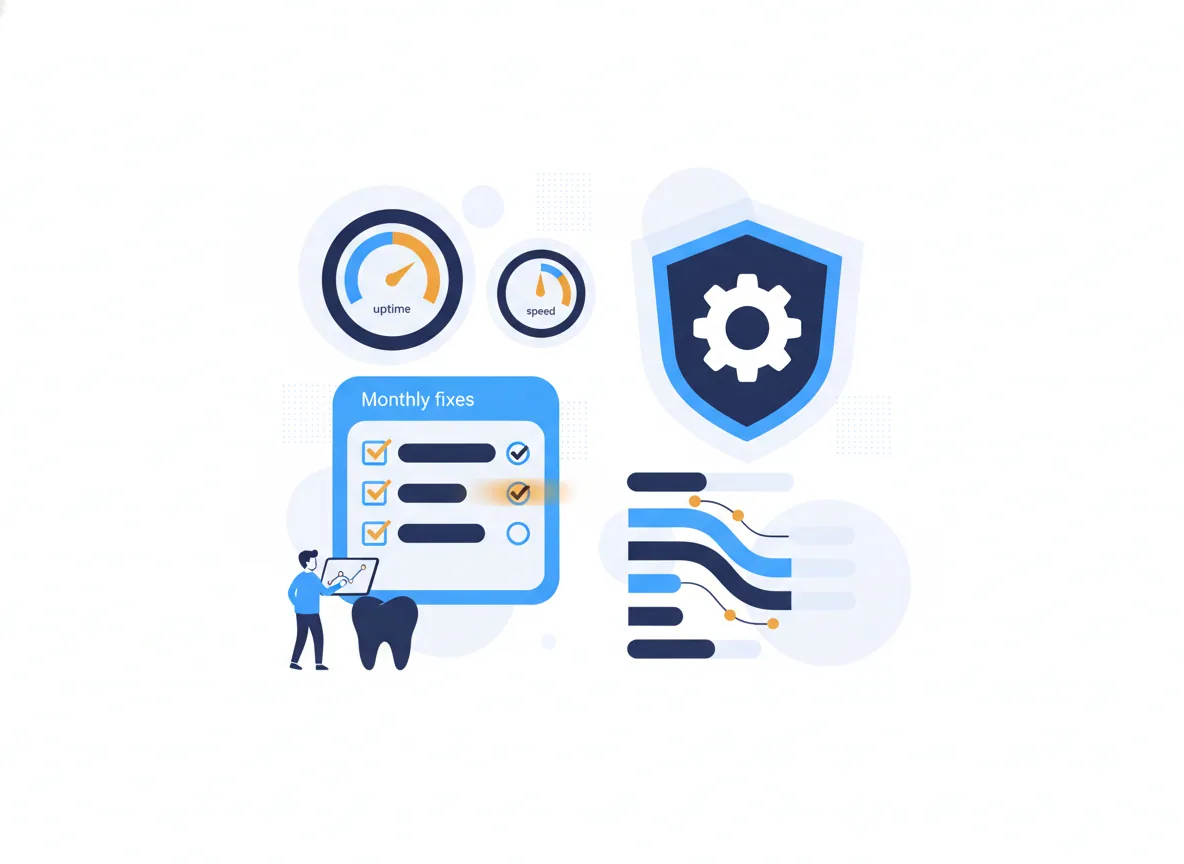
Building a high-performing dental website requires an upfront investment in structural design and an ongoing monthly budget for technical maintenance and secure hosting. For most practices, understanding a data-driven breakdown of modern dentists website services budgets reveals a clear divide between the initial capital needed for a reliable build and the predictable retainer required to keep the site fast, secure, and optimized for patient conversions.
Allocating capital to your digital presence goes far beyond picking a color scheme and uploading a logo. A functional, high-converting dental website is a complex software asset. When you budget for a new build, you are paying for user experience architecture, specialized technical compliance, and conversion rate optimization. The foundation of your dentists website services investment depends heavily on the specific functionality your practice requires to operate efficiently.
Dental websites handle sensitive patient information. Every contact form, appointment request, and patient portal integration must meet strict privacy standards. Budgeting for a dental website means allocating funds for encrypted form processors, secure sockets layer (SSL) certificate management, and dedicated hosting environments that protect protected health information (PHI). Attempting to cut costs on basic shared hosting puts your practice at severe regulatory risk.
The majority of your prospective patients search for local dental services on their smartphones. Your website budget must account for distinct mobile development. A mobile-responsive design ensures your site fluidly adapts to any screen size, but true mobile optimization includes engineering the site to load in under three seconds. Search engines penalize slow websites, meaning a cheap, bloated website directly harms your visibility. High-end web development focuses on lean code, optimized images, and efficient server response times.
Budgeting for a website build requires honesty about the difference between an off-the-shelf template and a fully custom digital asset. Standard pricing ranges depend on the scope of the project, the size of your practice, and the level of custom integration required.
For newer practices or solo operators with tight capital constraints, template-based websites offer a functional starting point. These builds require a smaller upfront investment because the foundational code and design layout already exist. The agency applies your branding, uploads your content, and connects your domain. While the initial cost is lower, template sites often struggle with complex SEO requirements and unique branding demands. If you partner with a small business marketing agency, they can help you determine if a template provides enough functionality for your current growth stage.
Established practices competing in saturated urban or suburban markets require custom development. A custom performance build starts with user research and wireframing, moving into unique graphic design and custom coding. This tier demands a significant upfront investment, often spanning several months of development time. However, this approach yields a much higher return on investment because every element is engineered specifically to convert local traffic into booked appointments. You can review professional website services to understand the structural differences between basic setups and performance architecture.
A website budget is never a one-time expense. You must allocate a monthly budget for routine maintenance. This includes hosting fees, software updates, plugin compatibility checks, regular malware scans, and daily backups. Without consistent maintenance, even the most expensive custom website will degrade, slow down, and eventually break. A realistic budget accounts for a predictable monthly retainer to keep the asset functioning flawlessly.
Transparency is the most critical element of any agency partnership. The dental marketing industry is unfortunately filled with predatory pricing models that disguise the true cost of digital ownership. ITZ Digital focuses on designing transparent, scalable billing profiles that eliminate marketing waste, ensuring you understand exactly where every dollar goes.
Many agencies charge high monthly retainers while obscuring the actual work being performed. They roll website hosting, basic SEO, and arbitrary management fees into a single invoice. Worse, some agencies build your site on a proprietary content management system (CMS). This means you never actually own your website; you merely rent it. If you attempt to leave the agency, you lose your entire digital presence. You can avoid this by researching the high-performing dental website providers and insisting on full administrative ownership and an open-source CMS like WordPress.
A transparent billing profile separates capital expenditures (the initial build) from operational expenditures (monthly hosting and technical support). Results-oriented asset tracking means your monthly reports focus on specific financial metrics: organic traffic growth, conversion rates on specific service pages, and the actual cost per booked patient. You pay for verifiable maintenance and measurable performance, not hidden management fees.
Even with an adequate budget, website projects routinely fail due to poor planning and misaligned objectives. Understanding these common pitfalls allows your practice to navigate the development process without wasting capital or extending timelines unnecessarily.
The most common cause of budget overruns and delayed launches is a lack of prepared content. Agencies can build the framework of a beautiful website, but they need the actual words, doctor biographies, and practice photography to finish the job. When practices fail to provide this content on schedule, the project stalls. Define exactly who is responsible for writing the service pages—whether you are paying the agency for professional copywriting or handling it internally—before signing a contract.
A website that looks beautiful but fails to generate leads is a liability. Practice owners often fall in love with complex animations, massive video backgrounds, and unconventional navigation menus. These elements drastically slow down page speed and confuse users. Patients visit your site to find your phone number, verify your location, check your accepted insurance, and book an appointment. Any design choice that distracts from these core actions harms your ROI.
Your website is not a digital brochure; it is the central hub for dentists customer acquisition. Every dollar spent on design and development must serve the ultimate goal of turning an anonymous visitor into a patient in your chair. This requires a dedicated focus on conversion rate optimization (CRO).
Effective CRO for dental practices involves strategic placement of primary calls-to-action (CTAs). Phone numbers should be highly visible and clickable on mobile devices. Appointment request forms should be short, asking only for essential information to reduce friction. Furthermore, the site must feature dedicated landing pages for specific high-value services. If a patient is searching for dental implants, they should land on a page entirely dedicated to implants, rather than a generic homepage. By aligning your site structure with patient intent, you maximize the efficiency of your acquisition budget.
Your website budget cannot be planned in isolation from your broader marketing strategy. The architecture of your site dictates the success of your ongoing campaigns. Proper digital marketing for dentists requires a robust structural foundation to support both organic search optimization and paid advertising.
If you plan to run Google Ads, your website must support distinct, trackable landing pages that match the exact keywords you are bidding on. If your strategy relies on long-term organic growth, your site architecture must allow for easily updated blogs, localized service pages, and dynamic internal linking structures. You must ensure your site is compatible with the tools designed for scalable dental search optimization. Attempting to bolt a comprehensive marketing strategy onto a poorly constructed website results in wasted ad spend and stagnant organic rankings. It is crucial to review how the core agencies shaping the dental market integrate web development with comprehensive marketing initiatives.
As your practice grows, your digital infrastructure must grow with it. Budgeting for future scalability prevents you from having to rebuild your website entirely when you expand your business. To effectively scale dentists online, your website architecture must easily accommodate new locations, new practitioners, and new service lines.
If you plan to open a second or third location, your website needs a multi-location hierarchy. This involves creating distinct location pages with unique URLs, specific localized content, embedded maps, and distinct contact information for each office. This structure prevents Google from confusing your locations and ensures local patients find the office nearest to them. A scalable website budget accounts for a flexible CMS that allows your team to add new pages, update staff profiles, and post new content without requiring a complete redesign or exorbitant hourly development fees.
Approaching your website as an investment rather than an expense changes how you allocate your budget. By prioritizing transparent billing, demanding full ownership of your digital assets, and focusing on structural performance over superficial aesthetics, your practice can build a digital engine that consistently drives new patient acquisition. Define your technical requirements early, prepare your content aggressively, and partner with a team that measures success by your booked appointments rather than their management fees.
A dental website requires an upfront capital investment for the build and an ongoing monthly budget for hosting and maintenance. Custom designs cost significantly more than template-based sites but offer better conversion rates. Your exact budget depends on practice size, required features like HIPAA-compliant forms, and technical complexity.
Agencies charge ongoing monthly fees to cover secure hosting, plugin updates, security monitoring, and regular backups. A dental website is not a static asset; it requires continuous technical maintenance to protect patient data and maintain search engine visibility. Paying for active maintenance prevents costly security breaches and downtime.
You own your dental practice website only if your agency builds it on an open-source platform and transfers the administrative rights to you. Many practices unknowingly sign contracts for proprietary platforms, meaning they rent the site and lose their digital assets if they cancel the marketing agreement. Always demand full ownership.
Launching a custom dental website usually takes between three and six months from initial discovery to final deployment. This timeframe accounts for custom design iterations, technical development, content creation, and rigorous compliance testing. Template-based websites move faster but sacrifice the unique branding and structural flexibility of a custom build.
Keep reading
Website Services
Turn your dental practice website into a patient acquisition engine with clear user mapping, automated lead cascades, and conversion-focused architecture.

Website Services
Discover the real investment behind a high-performing dental website. This guide breaks down costs, outlines ROI, and reveals how ITZ Digital offers transparent, scalable web…

Website Services
Discover advanced dentists web design techniques from ITZ Digital, focusing on user behavior mapping, automated lead capture, and custom audience segmentation to help your…
Find out how we can help your business succeed.
Free audit of your market, your competitors and the gap between them.
Free audit · No obligation · No long-term contract