

Optimising against broken tracking
Most accounts we inherit have double-counted or missing conversions. Every "improvement" made before that is fixed is a guess.
Search Engine Optimization
Local SEO compounds. Unlike an ad campaign that stops the moment you stop paying, a well-optimised Google Business Profile and a clean on-page foundation keep earning clicks month after month — which is why cost per lead usually falls as rankings climb.
In plain terms
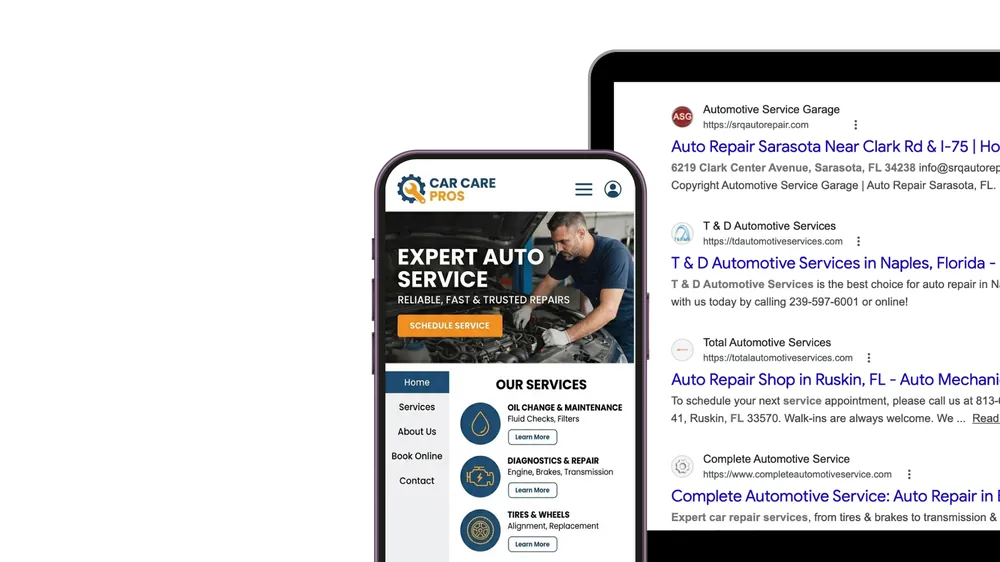
SEO is the one channel that keeps paying after the invoice clears. A paid campaign stops producing the day the card is declined; a clean site, a complete Google Business Profile and a page structure that matches real search demand keep pulling in clicks month after month. That is why cost per lead usually falls over the first two quarters — organic traffic starts doing the work paid clicks used to.
It is also slow, and anyone who tells you otherwise is selling something. Technical fixes and Business Profile work land fastest. Content and links compound over months. We treat the first 90 days as foundation work — getting tracking right, fixing what caps everything above it — and judge the account on booked calls and forms, not on a rankings screenshot.

Every term worth ranking for in your metro, scored by intent and difficulty, mapped to a page that should own it.
Titles, headings, internal links and schema corrected across the site — not just the homepage.
Google Business Profile, citations and review generation, kept consistent across every directory that matters.
Rankings, traffic and — the number that actually matters — booked calls and submitted forms.
The engagement
The sequence rarely changes, even though every account does. Fix the foundation, launch what is fast, then compound.
Weeks 1–2
Technical and content audit, keyword and competitor map, and a fix list ordered by impact. Conversion tracking gets verified or rebuilt first.
Weeks 3–6
On-page rebuild — titles, headings, internal links, schema — plus Google Business Profile and citation cleanup. The fastest-moving levers first.
Months 2–4
Page architecture built around real search demand: one strong page per service and location worth ranking for, and a review-generation workflow.
Ongoing
Content that answers buyer questions, ethical link acquisition, and monthly reporting led by calls and forms rather than rankings alone.
Fit
And who it isn’t
Skip SEO if you need cases or patients booked this month, or if you are launching with no site, no reviews and no local history. Paid search will get the phone moving faster while the organic foundation gets built underneath it.
What goes wrong
The failure modes we see most often when this channel is run without discipline — worth checking your current setup against.
Most accounts we inherit have double-counted or missing conversions. Every "improvement" made before that is fixed is a guess.
A single "Services" page cannot outrank competitors who built a dedicated page per service. Depth beats breadth in local search.
Position one for a term nobody searches is worthless. We map keywords to intent and buying value, not just volume.
How we measure it
Booked jobs are the goal. These are the earlier reads that tell us the channel is on track to get there.
As organic rankings climb, the blended cost per lead falls because free traffic takes on work that paid clicks were doing.
Calls and forms from people who found you without searching your name — the clearest sign the foundation is working.
Where you sit in the local three-pack for your core services, tracked over time. Movement here usually precedes call volume.
The point of SEO: turn off paid for a week and the phone still rings, because the organic asset is doing its job.
Go deeper
Questions
Expect first ranking movement around 90 days and a real change in lead volume between months four and six. Technical fixes and Google Business Profile work land fastest. Content and links compound slowly. If your site has been migrated badly, penalized, or never had a sane page structure, add a couple of months before anything moves at all.
The number is driven by how many services and cities you need to rank in, how far behind your technical foundation is, and how entrenched the incumbents are. A single-location practice targeting one metro costs a fraction of a firm covering six suburbs and four practice areas. We scope it after an audit, so you see the plan and the price together.
No, and neither can anyone else. Google does not sell placement in organic results. What we commit to is the work: technical fixes, page architecture, Google Business Profile, review generation, links. We report rankings, but we judge the account on calls and submitted forms. An agency guaranteeing position one is either targeting terms nobody searches or assuming you will not check.
They decay rather than vanish. The technical fixes and the pages stay in place, so the slide is gradual, usually over several months as competitors keep publishing and your review velocity drops. You keep the site, the analytics and the Google Business Profile either way. But SEO is a compounding asset, and stopping early is where most of the money gets wasted.
Find out how we can help your business succeed.
Tell us your market and target job type. We come back with the demand, the competition and a number.
Free audit · No obligation · No long-term contract
Where we run it
Local search results differ block by block. These pages cover the market specifics, competitors and pricing for each metro we actively run campaigns in.
Denver metro search is split across a dense downtown core and a ring of suburbs with their own map packs. A single city-wide campaign leaves the suburban rings uncovered.
Learn moreAustin has one of the fastest-growing populations in the country, which means high search volume and a constant stream of new competitors bidding on the same terms.
Learn moreThe Valley sprawls across more than 500 square miles, so proximity ranking factors dominate. Ranking downtown does almost nothing for demand in Scottsdale or Mesa.
Learn moreAlso worth a look