

Home Services marketing
Home services marketing for an urgent, proximity-driven decision
HVAC, plumbing and roofing jobs are won by the company that shows up in the map pack, answers the phone, and looks trustworthy in the reviews. Everything we run points at those three.

<1hr
Window before an emergency-service caller has phoned a competitor
Specialisations
Where home services campaigns actually differ
Each of these has its own search behaviour, its own compliance constraints and its own definition of a good lead. We run them as separate strategies.


Our approach
How we run home services campaigns
The playbook that consistently works in home services — and the parts most generalist agencies skip.
01
Own the map pack, then the after-hours call
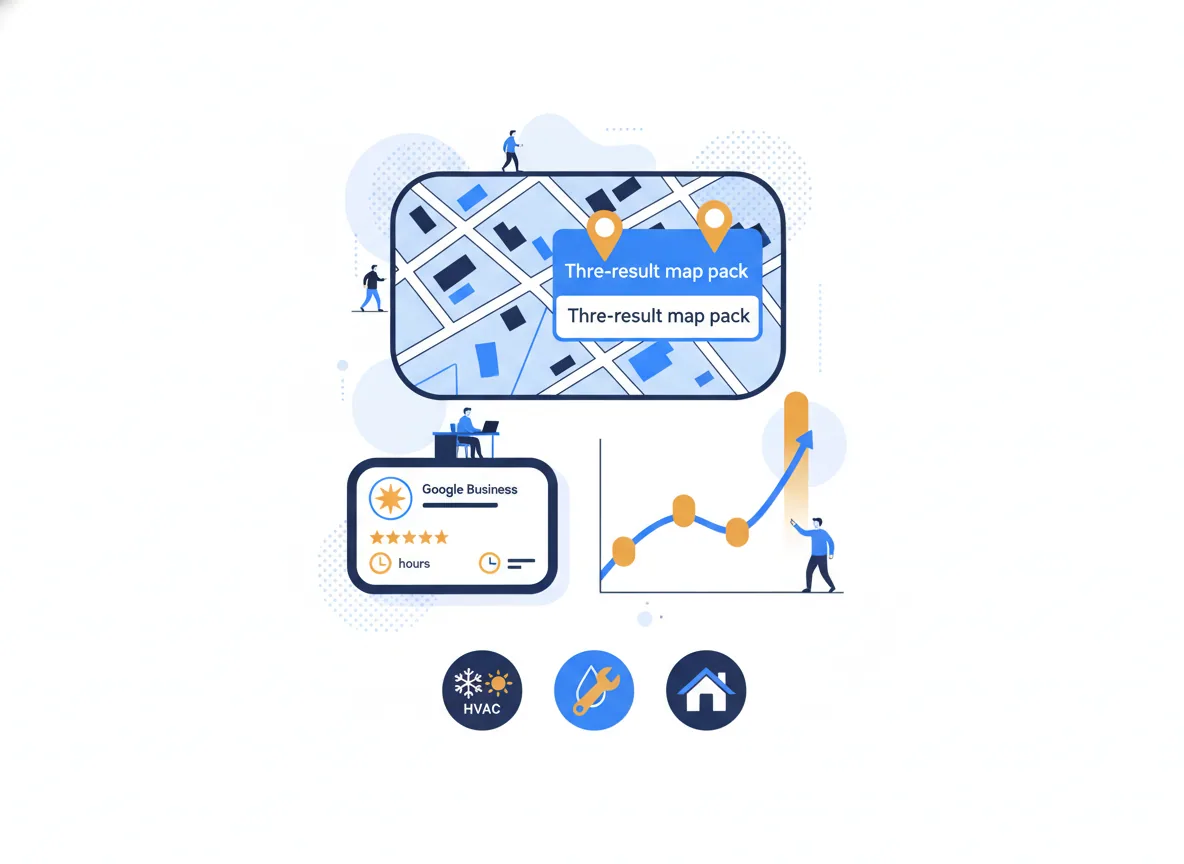
The emergency jobs come from the local three-pack, so that is where the first work goes: complete trade and service categories, accurate hours including nights and weekends, real photos of your crews and trucks, and a steady flow of recent reviews. Then we make sure the after-hours ad schedule is live and the phone path actually books a truck — because the map-pack ranking is wasted if the third ring goes to voicemail.

02
A campaign per trade, paced to the season
HVAC, plumbing and roofing have different search terms, different competitors, different margins and completely different calendars. We run each as its own campaign with its own budget, and we pace that budget against the forecast — bid up before the heat wave or the freeze, hold a base through the shoulder season, surge within days of a storm. One blended campaign spends your winter budget on summer clicks.

03
Separate the $99 call from the $12,000 job
A drain clear and a full system replacement are different buyers on different timelines, and marketing them the same way wastes budget on both ends. Emergency and low-ticket work gets proximity-and-speed campaigns and instant booking; replacements, repipes and re-roofs get research-stage content, financing messaging, and a quote-request conversion with real follow-up. Reporting is split by job type so you can see which one is paying.
The market
How home services buyers actually decide
Almost every one of these jobs starts with something broken and a homeowner on a phone. They open the map pack, read the rating and the two most recent reviews, and call the first company that looks capable and can come today. If nobody answers, they call the next one on the list. Speed to a live answer decides more of these jobs than anything on the website.
Underneath sits a trust problem — people expect to be overcharged or upsold — so photos of real technicians, upfront pricing ranges, written estimates and a clear warranty do more work than a coupon. Demand is highly seasonal and weather-driven: air conditioning in the first heat wave, heating in the first freeze, roofing and water damage after a storm. Higher-ticket work — a system replacement, a re-roof, a repipe — is considered for days or weeks, which is where paid social, retargeting and financing messaging earn their place.
The other constant is the trust deficit. Home-services buyers have heard the horror stories — the surprise upsell, the storm-chaser who vanished, the "diagnostic fee" that became a four-figure bill — so the companies that win lead with the things a bad operator cannot fake: named technicians with photos, published pricing ranges, written estimates, a real warranty, and a review history that is long and specific rather than a recent burst of five stars.
Financing is a quiet lever on the high-ticket work. A homeowner facing a $9,000 system replacement or a $15,000 re-roof is often choosing between "do it now on a payment plan" and "patch it and wait" — and the company that makes the monthly number visible early, on the page and in retargeting, captures the jobs the others lose to hesitation.
Why us
What you get from an agency that knows home services
Window before an emergency-service caller has phoned a competitor — that is the number this work has to move.
- Map pack first: service categories, hours (including after-hours and weekends), photos and a steady flow of recent reviews, since that is where the emergency calls come from.
- Call tracking with recordings, reviewed with your dispatch team, so you can hear how many booked jobs the phone is losing.
- Campaigns split by trade, urgency and ticket size, so a $99 drain clear and a $12,000 system replacement are not bought the same way.
- Seasonal budgets set ahead of the curve — bid up before the heat wave, not after — and service-radius targeting matched to how far your trucks actually drive.
How we know it's working
What we watch, month to month
Booked work is the goal, but it lags. These are the earlier signals that tell us a home services campaign is on track.
Booked jobs by trade
Not calls — trucks actually dispatched or estimates actually scheduled, tagged to the trade and the campaign. This is the number each per-trade campaign lives or dies on.
Call answer rate and time to dispatch
How many campaign calls are answered live, and how fast a truck is booked, tracked with recordings. For emergency work this is usually where jobs are won or lost, and it is fixable in weeks.
Average ticket and replacement share
Whether the mix is moving toward the higher-value work you want. A ringing phone with a flat, low average ticket means the targeting is pulling coupon shoppers.
Seasonal capture
Whether you were live, funded and bid up before this year’s heat wave, freeze or storm — versus scrambling to catch up a week after it started.
What we run
Channels that work for home services businesses
Programmatic Ads
Google Business Profile per location, a page per trade and per town you cover, and a review workflow the technician triggers at the end of the job.
Learn moreSearch Engine Optimization
Local Services Ads (verification and weekly lead disputes handled), plus search campaigns bid up ahead of the season and offer campaigns for the slow weeks.
Learn morePPC Management
Trade and town pages with upfront pricing ranges, financing on the replacement work, and the shortest possible path to booking a service call.
Learn more


Questions
Home Services marketing: common questions
What home services owners ask us most often before starting.
Proximity, relevance and prominence, roughly in that order, and proximity is fixed. What you can change: complete and accurate service categories and attributes, correct hours including nights and weekends if you run emergency service, a page on your site for each service and each town you cover, real photos of your team and trucks posted regularly, and a steady stream of new reviews. In a competitive metro this is a months-long effort, and a company based on one side of town will always struggle to rank on the far side.
Partly. Price shoppers come from ads that lead with a discount and from pages with no pricing information, which forces the phone call. Publishing service-call fees, diagnostic charges and typical ranges filters out some of them before they dial. The rest is a phone script: answer the price question, then pivot to the diagnosis and the appointment. We can send better-qualified traffic; we cannot turn a coupon shopper into a system-replacement customer.
Only if your technicians reliably convert that visit into real work and you can absorb the truck time. Track average ticket and 12-month revenue from tune-up customers before you scale it. Many companies do better advertising a specific repair they are known for, their emergency response time, or financing on replacements — offers that bring in customers who are not primarily chasing the lowest price.
Several. Each trade has its own search terms, its own seasonality, its own competitors and its own margin profile. One blended campaign spends your heating budget on plumbing clicks in July. We build a campaign per trade, each with its own pages, budget and seasonal pacing, reporting on booked jobs by trade so you can see which one is actually paying.
Find out how we can help your business succeed.
Ready to grow your home services business?
Free audit of your current visibility, your competitors and the gap between them.
Free audit · No obligation · No long-term contract
Other industries