

Designing before the content exists
Templates built around placeholder text break the moment real copy arrives. Content and design have to move together.
Website Design
Most small business sites lose the visitor in the first eight seconds. We design around the two things a local buyer wants: proof you can do the job, and an obvious way to reach you.

In plain terms
A marketing website has one job: turn the visitor a campaign paid for into a call or a form. We design around that — the questions a buyer needs answered, the proof that reassures them, and the shortest credible path to contact — then build it fast and keep it that way.
This is not a brand-agency exercise in art direction. It is a conversion tool that also happens to look current. Every page earns its place by moving someone closer to booking, and the structure is built so SEO and paid campaigns have somewhere good to land.
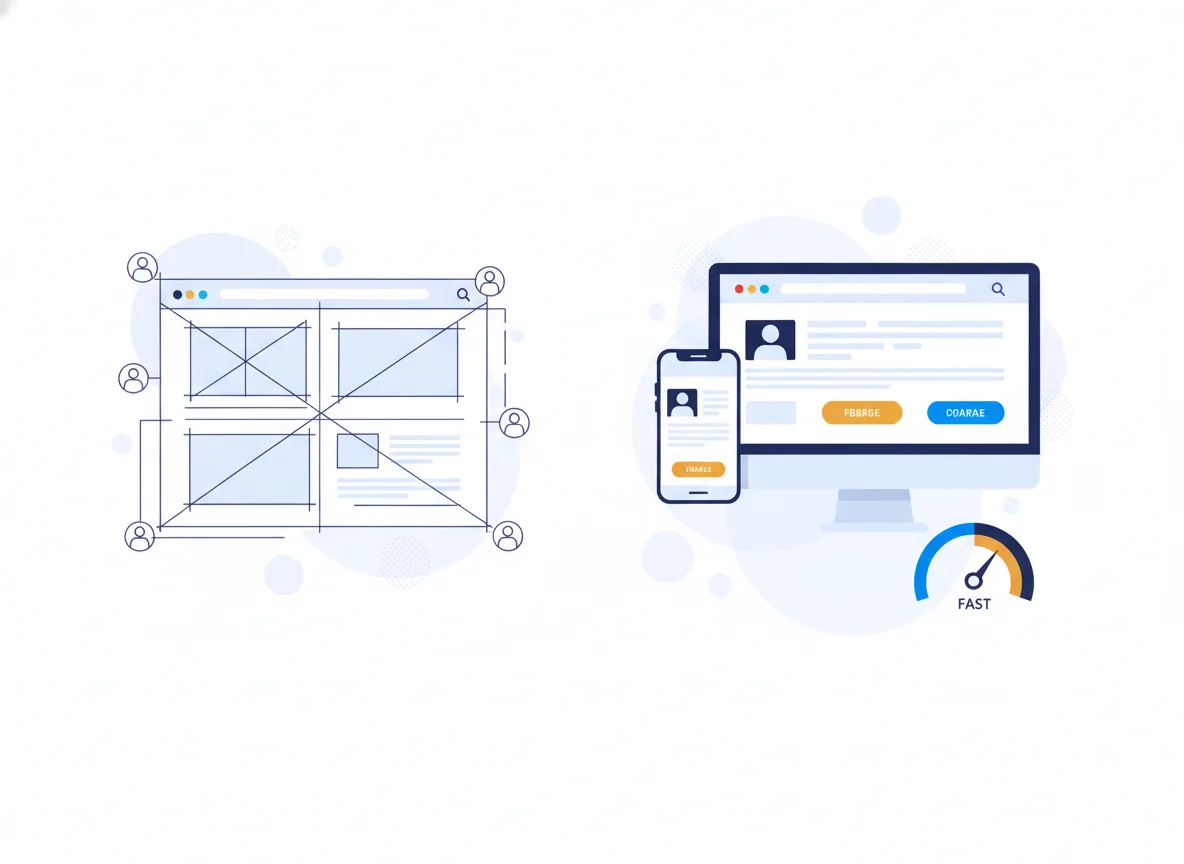
Page structure agreed before a pixel of visual design, so the argument happens early and cheap.
Colour, type and component library so every future page stays on brand without a designer.
Responsive build, QA across real devices, redirects mapped so you keep your rankings.
Heatmaps and form analytics for the first 90 days, with fixes applied as the data lands.
The engagement
The sequence rarely changes, even though every account does. Fix the foundation, launch what is fast, then compound.
Weeks 1–2
Discovery: who buys, what they need to know, what stops them, and which pages the paid and organic plans need. Sitemap and wireframes.
Weeks 3–5
Design of the key templates — home, service, location, contact — reviewed against real content, not lorem ipsum.
Weeks 6–8
Build on a fast, maintainable stack, with tracking, schema and accessibility baked in rather than bolted on.
Launch
Redirect mapping so existing rankings survive, QA across devices, and a staged cutover. Then a care plan keeps it fast.
Fit
And who it isn’t
Not for anyone who needs a site live next week for a few hundred dollars. Use a template builder for that, honestly. Our process runs through wireframes, content and revisions, and it is not the cheapest way to get a page on the internet.
What goes wrong
The failure modes we see most often when this channel is run without discipline — worth checking your current setup against.
Templates built around placeholder text break the moment real copy arrives. Content and design have to move together.
A rebuild without a redirect map throws away years of SEO overnight. This is the most common and most expensive launch mistake.
Heavy hero videos and animation libraries that look great on the designer’s laptop and cost you the mobile visitor.
How we measure it
Booked jobs are the goal. These are the earlier reads that tell us the channel is on track to get there.
More of the traffic you already pay for turns into calls and forms, because the page answers objections instead of just describing services.
A redirect map and clean migration mean organic traffic holds through launch rather than cratering.
The site loads quickly on the mid-range Android a real customer is holding, not just on office wifi.
Service and location pages structured so SEO and paid have strong, relevant places to send traffic.
Questions
Usually six to ten weeks for a standard small business site. Design and build are the predictable part. The delay is almost always content: photos, staff bios, service descriptions and approvals. Clients who block out time for content in week one finish near the low end. Projects waiting on one busy decision-maker's inbox run long, every time.
Page count, custom functionality, and how much of the writing we do versus you supply. Eight pages with copy you provide sits at one end. A multi-location site with online booking, intake forms, CRM integration and a written page for every service and city sits at the other. Photography, if it needs to be shot, is a separate line rather than a hidden markup.
Not if the migration is handled properly. Every existing URL gets mapped to its new equivalent with a permanent redirect, and titles, headings and page content carry over rather than being rewritten from scratch. Expect a short wobble while Google recrawls. Ranking losses after a redesign nearly always trace back to launching without a redirect map.
Yes, and we treat that as a build requirement rather than an afterthought. You get a stack your staff can update for pages, text, images, staff and posts, plus a recorded walkthrough. Structural changes and new templates still need a developer. If nobody on your team wants to touch it, the maintenance plan covers edits instead.
Find out how we can help your business succeed.
Tell us your market and target job type. We come back with the demand, the competition and a number.
Free audit · No obligation · No long-term contract
Also worth a look