To dominate your local market, your practice website must stop acting like a digital brochure and start functioning as a patient acquisition engine. Advanced chiropractor website services rely on mapped user behavior, automated lead cascades, and clear audience segmentation to turn casual traffic into booked appointments. If your site just lists your hours and a generic stock photo of a spine, you are losing patients to competitors who make booking frictionless. Your website is your digital front door. It needs to operate with the same efficiency and precision as your front desk staff, capturing leads and routing patients to the right care protocols around the clock.
Mapping Patient Behavior to Drive Bookings
Patients land on your site for entirely different reasons. Some woke up with acute neck pain and need an adjustment immediately. Others are researching chronic pain solutions after a car accident. You cannot treat these two visitors the same way. User behavior mapping tracks exactly how different visitors navigate your pages, click your buttons, and read your content. By understanding these patterns, you can optimize the digital path to your clinic.
Identifying Acute Versus Chronic Search Intent
When someone searches for acute sciatica relief, they want immediate validation that you treat their specific problem and have an open appointment slot. If they land on your homepage and have to hunt through three drop-down menus to find a "services" tab, they will leave. You need dedicated landing pages for every specific condition you treat. The design must accommodate the user's intent: acute patients need prominent phone numbers and online booking calendars at the top of the page. Chronic care patients need educational content, doctor biographies, and detailed explanations of your treatment modalities, such as spinal decompression or soft tissue work.
Use heatmap software and scroll tracking to see where users drop off. If users abandon your scheduling page, your form is likely too long. If they click your phone number but do not call, your mobile site might be serving unclickable text instead of a direct link. Removing these friction points directly increases your conversion rate.
Designing the Mobile-First Experience
The vast majority of your traffic comes from mobile devices. Your site must load instantly on cellular networks, not just on high-speed clinic Wi-Fi. The "Call Now" and "Book Appointment" buttons should remain pinned to the bottom of the screen as the user scrolls. Mobile users do not want to pinch and zoom to read your intake requirements. Every paragraph must be short, and every button must be large enough to tap easily with a thumb.
Building Automated Lead Capturing Cascades
A single "Contact Us" form hidden on a subpage is not an acquisition strategy. You need automated lead capturing cascades that catch visitors at different stages of their decision-making process. These cascades operate as safety nets, ensuring that even if a visitor is not ready to book today, you still capture their information for future marketing efforts.
Implementing Multi-Step Conversion Forms
Not everyone is ready to book a consultation on the first visit. Offer a soft conversion. A downloadable guide on posture correction for desk workers or stretching exercises for lower back pain captures an email address. Once you have that email, an automated sequence follows up over the next week to build trust, share patient success stories, and prompt a booking.
For high-intent visitors ready to schedule, simplify the booking cascade. Use a multi-step form that asks one question at a time. First, ask what body part hurts. Second, ask if they have been in an auto accident or suffered a sports injury. Third, ask for their name and phone number. This micro-commitment approach reduces form abandonment significantly compared to a massive single-page questionnaire. If your forms are broken or confusing, testing different strategies to scale your practice through new patient acquisition will only burn your marketing capital.
CRM Integration and Speed to Lead
Capturing the lead is only half the battle. Your website must integrate directly with a Customer Relationship Management (CRM) system. When a prospective patient fills out a form, the data should immediately populate in your system. This action must trigger an internal SMS or notification to your front desk, instructing them to call the lead immediately. It should also send an automated, personalized text message to the patient confirming you received their request. Speed to lead is critical in the medical field. If your front desk calls a prospect back four hours after they requested an appointment, that patient has already booked with the chiropractor down the street.
Custom Audience Segmentation Configurations
Effective digital marketing for chiropractor campaigns relies heavily on tracking who does what on your site. You need custom audience segmentation configurations built into your website architecture from day one. By segmenting your website traffic based on page views and behavior, you can run highly targeted advertising campaigns that lower your cost per acquisition.
Structuring Your Site for Segmentation
When a visitor spends three minutes reading your page on whiplash treatment and auto accident recovery, your site should tag them with a specific tracking pixel. If they leave without booking, your retargeting campaigns on Meta or Google can now serve them specific ads about auto-injury recovery, rather than generic chiropractic adjustments. This level of technical setup requires leaning on core solutions that capture high-intent traffic rather than relying on basic web builders that lack advanced tracking capabilities.
Build distinct silos on your website to make this possible. Group all sports injury content together. Group all pediatric chiropractic content together. Group all personal injury content together. This structure helps search engines understand your authority in specific sub-niches and helps you organize your tracking data. When you segment your most valuable patients—such as those seeking high-margin treatments—you can feed that data back to advertising platforms to find similar local users.
The Real Cost of a High-Performing Chiropractic Website
Let us talk about what a proper chiropractor website services investment actually entails. Many practice owners try to cut corners with cheap website builders or heavily templated services, only to find the site generates zero new patients and ranks poorly on search engines. You get exactly what you pay for in digital real estate.
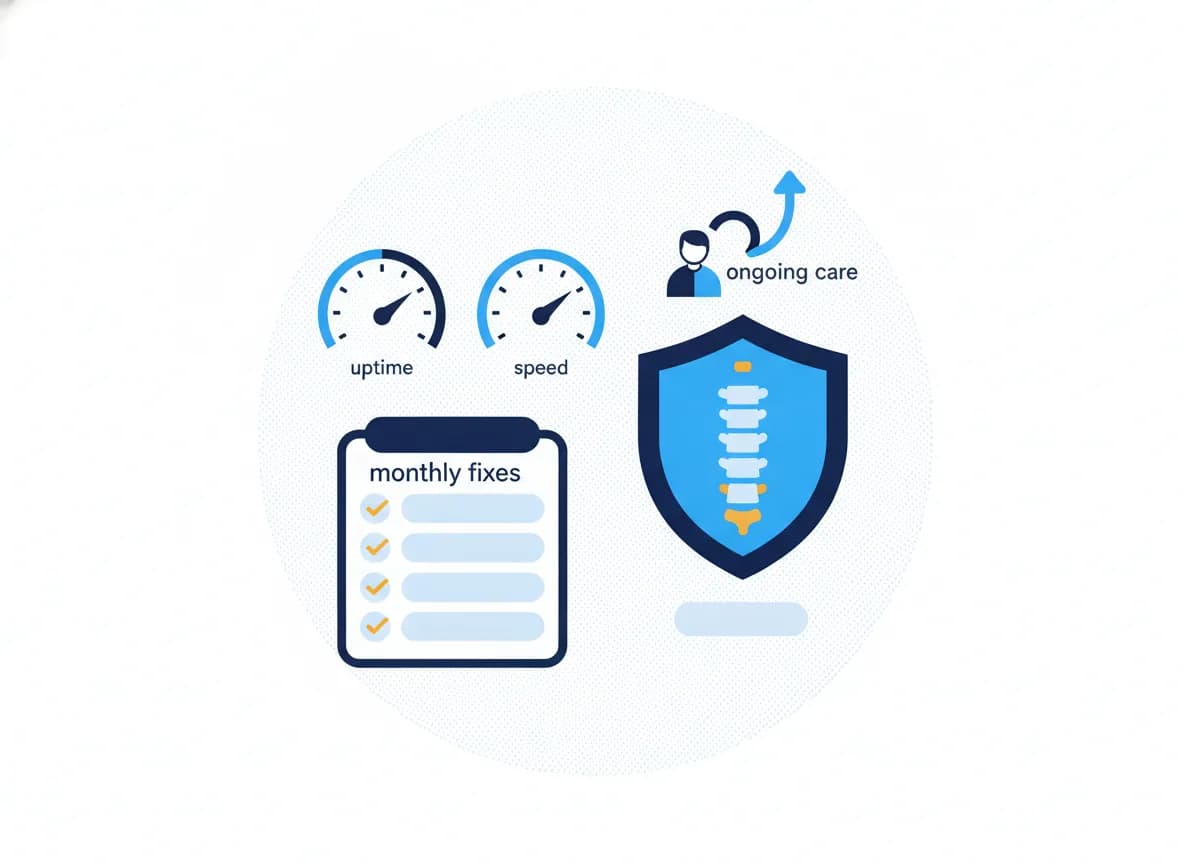
A performance-driven website requires a solid initial build and ongoing optimization. You are paying for fast managed hosting, custom copywriting that speaks to your local market, technical SEO structure, and secure form handling. Expect a custom, high-converting practice website to require a serious upfront outlay. Beyond the initial launch, you need a recurring monthly budget for software updates, security patches, plugin maintenance, and conversion rate testing.
Before you start a complete digital rebuild, you must budget effectively for new patient growth across your entire marketing plan. A brilliant website without ad traffic or SEO visibility is useless, and paid traffic sent to a broken, slow website is a complete waste of money. If you need a total digital overhaul, utilizing professional website design and maintenance services ensures the foundation is built correctly from the start. You must own your digital assets. Avoid rented websites from agencies that hold your domain hostage if you ever decide to cancel your contract.
Where Chiropractic Websites Typically Go Wrong
Even established, high-volume practices make critical digital errors that destroy their conversion rates. Fixing these foundational mistakes is the first step when attempting to scale chiropractor online presence.
Ignoring HIPAA Compliance on Web Forms
Capturing health information on standard, unencrypted contact forms is a massive liability. If your website asks patients to describe their pain, list their medications, or upload MRI reports, those forms must be fully HIPAA compliant. The data must be encrypted in transit and at rest. Your web host and form provider must sign a Business Associate Agreement (BAA). Sending new patient intake forms to a standard Gmail inbox puts your entire practice at risk.
Hiding the Phone Number and Burying the Call to Action
Your phone number should be the most visible element on the page, placed in the top right corner of the header. It must be a clickable link on mobile devices. Forcing a patient in acute pain to memorize or copy and paste your phone number is a guaranteed way to lose them. Furthermore, do not leave the patient guessing what to do next at the bottom of a page. Every service page should end with a clear call to action guiding them toward a single, obvious next step. "Book Your Appointment Now" should stand out in a contrasting color that draws the eye.
Using Generic Stock Photography
Patients want to know who is going to adjust them and what the clinic environment looks like. Sites filled with generic stock photos of smiling models in pristine, unrecognizable clinical settings look fake and build zero rapport. Use real, high-quality photos of your clinic exterior, your waiting room, your adjusting tables, your staff, and yourself. Authenticity builds the necessary trust required for a patient to let you manipulate their spine.
A Growth Checklist for Your Practice Website
To maximize chiropractor customer acquisition, you need a strict operational blueprint. Treat this checklist as your baseline for auditing and upgrading your current digital presence into a market-dominating platform.
- Audit Mobile Usability: Open your site on your phone right now. Try to book a new patient appointment. If it takes more than a minute or requires zooming in to tap a tiny button, fix your interface immediately.
- Implement Proper Tracking Pixels: Ensure Google Analytics 4, Meta Pixel, and Google Ads tracking tags are firing correctly on all pages. Verify that form submissions trigger conversion events.
- Build Condition-Specific Landing Pages: Stop grouping all your services onto one page. Create individual, highly detailed landing pages for back pain, neck pain, auto injuries, sciatica, and sports rehab.
- Optimize for Core Web Vitals: Compress all images, remove unused code bloat, and upgrade to premium managed hosting. Your site must load in under three seconds.
- Add Local Schema Markup: Help search engines easily crawl and index your local business details, including your exact office hours, physical location coordinates, and accepted insurance providers.
- Simplify Your Navigation: Limit your main header menu to five or six clear options. Keep the user focused on your core services and the booking process.
Executing this operational playbook requires technical discipline and ongoing refinement. You can always review our core philosophies on building scalable marketing systems by visiting our digital marketing agency homepage. Upgrading your website is not a one-time project; it is an ongoing commitment to capturing market share and providing an exceptional digital experience for every prospective patient.

 By Kayce Marty