
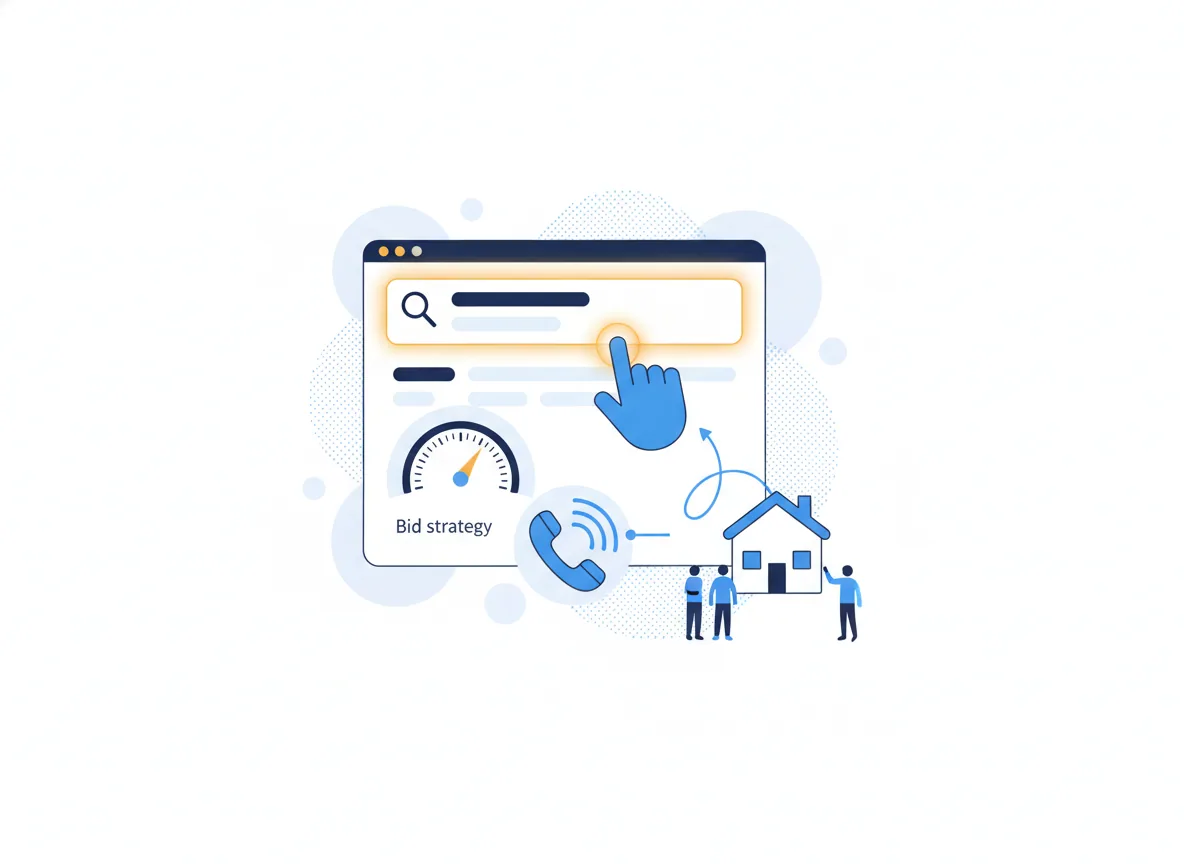
Google ads
The Comprehensive Guide to Real Estate Agent Google Ads Costs
Real estate Google Ads cost money, but wasted ad spend costs more. Learn how to structure your budget and track customer acquisition without hidden fees.
10 min read
Google ads
 By Raheim Binnie8 min read
Advanced real estate Google Ads requires moving beyond broad match "homes for sale" keywords and shifting to custom audience segmentation and precise user behavior mapping. To dominate your local market, you need a campaign structure that captures high-intent buyers and sellers exactly when they are ready to transact. A basic campaign will drain your budget on people looking for property estimates or rental apartments. An advanced operational playbook treats Google Ads as a precise customer acquisition system.
Most real estate campaigns fail because they treat all search traffic equally. User behavior mapping involves breaking down how people search based on where they sit in the buying or selling cycle. Someone searching your city's name plus "real estate" is browsing. Someone searching "sell inherited house fast" or "top listing agent near me" needs to hire you this week.
Your campaign architecture must separate these intents into entirely different campaigns. Mixing them guarantees that your budget will be eaten by high-volume, low-intent browser clicks before the highly qualified seller queries even happen.
Sellers represent the highest value target for most real estate practices. Because these leads are valuable, the clicks are expensive. You must map the exact phrasing a distressed or motivated seller uses.
Create specific ad groups for:
Send these clicks to a landing page tailored precisely to the ad group. If the ad text highlights selling a condo, the landing page must speak exclusively to condo owners. Do not send this highly specific traffic to your generic homepage.
Buyer campaigns often waste money on users who are years away from qualifying for a mortgage. Stop bidding on generic housing terms. Shift your focus to long-tail, high-intent buyer searches.
Target specific neighborhoods, school districts, or property constraints. Keywords like "new construction homes with pools in [City]" or "gated community homes for sale [Neighborhood]" show a buyer who has already done their broad research and narrowed their focus. They are much closer to contacting an agent to arrange a physical showing.
Keywords dictate relevance, but audiences dictate conversion probability. Advanced digital marketing for real estate agent platforms involves layering Google's audience data over your search campaigns. This practice is known as Observation and Targeting.
Upload your current CRM database into Google Ads as a Customer Match list. Segment this list into past clients, dead leads, and active prospects.
You can use this data to exclude current active prospects from seeing your ads, saving you money on clicks from people already in your pipeline. More importantly, you can set a positive bid adjustment for past clients. If a past client searches for a real estate agent three years after buying their home, you want to guarantee your ad appears at the absolute top of the search engine results page.
Google categorizes users based on their overall browsing behavior. Layer "In-Market for Residential Properties" over your search campaigns. Observe how this audience performs compared to the general public. Once you gather enough data, you can instruct Google to automatically bid higher when a searcher is mathematically proven to be actively shopping for a home across the broader internet.
Generating a click is only the first phase of real estate agent customer acquisition. The second phase is conversion, and the third is immediate contact. Real estate leads decay in minutes. If you do not respond immediately, the prospect will simply click the next ad on Google.
Your landing page must function as a frictionless conversion environment. Remove all outbound links, including main navigation menus and social media icons. The visitor has two choices: submit their information or close the tab.
Offer something of immediate, tangible value. For sellers, this is an accurate, data-driven home valuation produced by a local expert—not an automated estimate they can grab on a national portal. Offer a customized local market report or a consultation on home improvements that yield the highest return before listing.
Never rely on basic email notifications for new leads. Emails get lost in spam folders or delayed by servers. Set up an automated lead capturing cascade using webhooks.
When a user submits a form on your landing page or through a Google Lead Form Extension, a webhook must instantly push that data into your real estate CRM. Configure your CRM to automatically trigger an immediate SMS text message to the lead.
The automated text should read: "Hi [Name], I just received your request about the property in [Neighborhood]. I am reviewing the details now. Are you available for a quick five-minute call today?"
Simultaneously, the CRM must ping your phone or dialer system to prompt a direct call to the lead. This automated cascade ensures contact is initiated within sixty seconds of the searcher hitting submit.
Budgeting requires an honest look at the math of your specific market. There is no universal cost for a real estate lead. In a mid-sized Midwest market, a buyer lead might cost very little. In a highly competitive luxury coastal market, a seller lead will demand a massive premium.
Your daily budget must accommodate the cost of your specific local clicks. If a click for "listing agent near me" costs fifteen dollars, a ten-dollar daily budget means your ad will never show. You need enough daily budget to secure at least five to ten clicks per day to feed the Google Ads algorithm enough data to optimize.
Calculate your target return based on cost per acquisition, not just cost per lead. If you convert one out of every twenty leads, and a lead costs thirty dollars, your cost per acquisition is six hundred dollars. Compare that cost against your average transaction commission to determine if the campaign framework is profitable.
Expect this entire process to take time. Real estate sales cycles are notoriously long. You must commit to funding your Google Ads account for at least six months before you can accurately judge its impact on your closed revenue. Leads generated in month one frequently do not close until month four or five. Turning ads on and off every few weeks breaks Google's machine learning and ruins your campaign data.
Most real estate agents burn their marketing budgets within the first month because of structural setup errors. Google Ads defaults are designed to maximize Google's revenue, not yours. You have to manually adjust these settings.
The most common failure is leaving keyword match types set to broad match. If you broad match the keyword "real estate agent," Google will show your ad to people searching for "real estate agent salary," "how to become a real estate agent," and "real estate agent exam practice." You pay for every single one of those clicks. Use exact match and phrase match exclusively until your campaign is consistently profitable and you thoroughly understand your search terms report.
A negative keyword list tells Google when not to show your ad. Without a robust negative keyword list, you will buy irrelevant, low-intent traffic.
Add these terms to your negative list before you launch:
By default, Google sets location targeting to "Presence or Interest." This means if someone across the globe shows interest in your local market, they can trigger your ad. This is useful for specific destination markets, but disastrous for local residential agents. Change your location settings to "Presence: People in or regularly in your targeted locations." This strict setting ensures only local searchers see your ads.
The final point of failure happens entirely offline. If you buy high-quality traffic, capture the lead perfectly, but wait four hours to call them, you have wasted your money. Google Ads cannot fix a broken sales or intake process. If you cannot commit to immediate follow-up, pause your campaigns until you have the staff or automation in place to handle inbound volume properly.
Once you establish a profitable baseline, you must scale your efforts to capture more market share. To scale real estate agent online operations effectively does not just mean increasing your daily budget. It means expanding your targeting footprint and capturing secondary search intent.
When buyers and sellers are ready to make a move, they often search for the highest-producing agents or brokerages in the area by name. You can bid on the specific names of your local competitors. When someone searches for the top-producing team in your city, your ad can appear directly above their organic website listing, offering a compelling alternative. Keep your ad copy highly focused on your unique value proposition rather than attacking the competitor.
Do not rely on Google Search alone to maintain visibility. Once a user clicks your search ad, they enter your retargeting pool. Use Google Display and Meta Ads to follow that specific user across the internet.
If a seller clicks your search ad for home valuations, they should see your display ads on local news websites the next day, and your video testimonials in their social media feeds the day after that. This omnipresence builds trust and local familiarity. When they are finally ready to pick up the phone, your firm remains top of mind.
If you manage a large volume of active listings, Dynamic Search Ads can automate your keyword targeting. Google crawls your active property listing pages and automatically generates ads when someone searches for a phrase closely related to a specific property description. This ensures that every listing in your portfolio is actively marketed on search engines without your team having to build a manual ad group for every single house.
By carefully managing user intent, securing an appropriate daily budget, building rigorous automated follow-up cascades, and actively avoiding common setup traps, your real estate practice will transform Google Ads from a speculative expense into a highly reliable driver of closed transactions.
Your starting budget should allow for at least ten clicks per day in your specific local market. Real estate click costs vary widely based on competition and keyword intent, with seller leads generally costing more than buyer leads. Plan to commit to a consistent monthly spend for at least six months to accurately measure your return on investment.
Google Ads capture active intent, while Facebook Ads generate passive interest. When someone searches for a local listing agent on Google, they actively need immediate help. Use Google to capture high-intent traffic ready to transact, and deploy Facebook campaigns to retarget those search visitors or build general brand awareness in your farm area.
High clicks with zero leads usually indicate a disconnect between your ad copy and your landing page, or poor keyword match types. Review your search terms report to ensure you are not paying for apartment rental queries or broad national searches. Additionally, your landing page must provide an immediate, clear reason for the visitor to submit their contact details.
Expect to run campaigns for three to six months before closing your first transaction. While a well-built campaign can generate leads in the first week, the real estate buying and selling cycle naturally creates a delay between initial digital contact and a closed commission check. Consistency is required to see bottom-line results.
Keep reading
Google ads
Real estate Google Ads cost money, but wasted ad spend costs more. Learn how to structure your budget and track customer acquisition without hidden fees.

Website Services
Explore real estate website pricing tiers, setup and maintenance costs, and realistic ROI metrics to build a high-converting digital asset for your business.

Website Services
Learn the operational blueprints, behavioral tracking setups, and conversion architectures needed to turn your real estate website into a predictable client pipeline.
Find out how we can help your business succeed.
Free audit of your market, your competitors and the gap between them.
Free audit · No obligation · No long-term contract