
 By Chris Lee
Meta Ads
The Comprehensive Guide to Roofing Meta Ads Costs
Understand how much to invest in roofing Meta Ads and how to structure your campaigns for transparent, scalable growth without wasting budget.
8 min read
To win high-intent leads with Meta Ads, your roofing company must abandon the habit of boosting generic posts and implement a structured conversion campaign. A successful roofing Meta ads strategy relies on custom audience segmentation, highly localized ad creative, and automated lead capture cascades that immediately engage prospects. When homeowners scroll through their feeds, they are looking for entertainment and social updates, not a new roof. Your campaigns must interrupt that pattern with undeniable local relevance and clear offers that speak directly to their current property issues.
Generating leads is only half the equation. The true goal of your roofing customer acquisition effort is booking profitable inspections that convert into signed contracts. This requires a strict operational playbook. By aligning your targeting parameters with user behavior and setting up immediate technical follow-up systems, your roofing business can filter out renters and tire-kickers, ensuring your sales team focuses only on qualified homeowners.
Broad targeting burns through ad spend rapidly. To run a profitable campaign, your audience setup must be highly intentional. Meta's targeting capabilities have shifted heavily toward algorithmic delivery, but you still control the guardrails. Proper custom audience segmentation configurations ensure your ads only display to users capable of hiring you.
Never target an entire state or a massive regional radius unless your crews are prepared to drive three hours for an inspection. Define your service area using specific zip codes or a tight mileage radius around your office. More importantly, utilize exclusions. Exclude users who list their primary demographic as renters. If you strictly handle residential asphalt shingle replacements, you can also test excluding interests related to commercial real estate or mobile home parks to tighten your delivery.
The most powerful targeting asset you own is your past customer list. Export your CRM data containing the names, phone numbers, and email addresses of homeowners who have purchased full roof replacements from you over the past few years. Upload this list to Meta to create a Custom Audience. Meta uses this data to map the digital footprint of your ideal customer.
Once this Custom Audience is built, generate a Lookalike Audience based on those past buyers. Limit the Lookalike to your specific geographic service area. The algorithm will seek out local users who share the same online behavior, purchasing habits, and demographic markers as the people who have already handed you a check. This approach systematically improves lead quality.
Your ad creative serves as the ultimate filter. User behavior mapping involves understanding exactly what triggers a homeowner to stop scrolling and click. A homeowner missing shingles after a major windstorm has a completely different behavioral trigger than a homeowner looking to finance a roof replacement because their current one is twenty years old. Your creatives must address these specific scenarios directly.
When severe weather hits your service area, speed is critical. Storm damage creatives should call out the specific event and the specific city. A short video of your project manager standing on a local roof pointing out hail impacts carries tremendous weight. The ad copy must be direct: name the storm date, mention the neighborhoods affected, and offer a free structural assessment. The intent here is urgent, and the creative must match that urgency.
For standard retail replacements, homeowners usually delay the project out of financial fear. User behavior indicates they will ignore roofing ads until the pain of a leak outweighs the pain of the cost. To capture this audience earlier, your creative should focus on affordability. Highlight flexible financing options, monthly payment breakdowns, or seasonal promotions. Pair this copy with high-quality before-and-after photos of roofs in recognizable local neighborhoods.
Nothing kills conversion rates faster than generic stock photos of perfectly clean models pointing at pristine roofs. Homeowners want to hire a local crew they can trust. Use authentic imagery. Photos taken on an iPhone showing your actual team working, your branded trucks parked in a driveway, and the mess of a tear-off process perform exceptionally well. Authenticity stops the scroll.
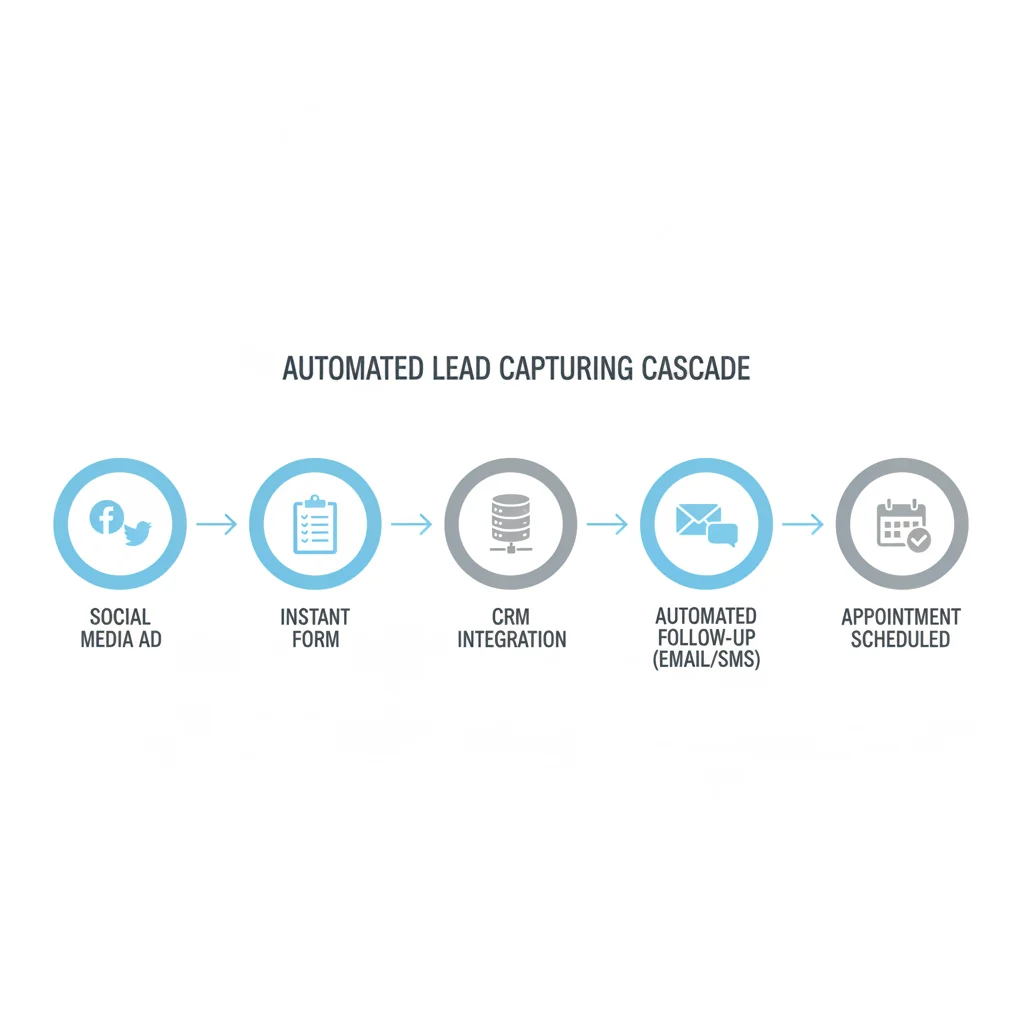
When a homeowner clicks your ad and submits their information, the clock starts ticking. The chance of contacting a lead drops significantly after the first five minutes. An automated lead capturing cascade ensures that every prospect receives immediate engagement without requiring manual intervention from your office staff.
If you use Meta's native lead forms, you must add custom qualifying questions. Asking for just a name and phone number will result in accidental submissions and low-intent leads. Require the user to type in their street address, select the age of their roof from a dropdown menu, and confirm they are the homeowner. This added friction reduces your total lead volume but dramatically increases the intent and quality of the leads you receive.
Never rely on manually downloading CSV files from Meta to check for new leads. Use an integration tool like Zapier to connect your Meta lead forms directly to your CRM. The moment a homeowner hits submit, the data must instantly populate into your sales pipeline, triggering a notification to your field reps.
Your automated cascade should trigger communication the second the CRM receives the lead. This sequence typically looks like this:
This process guarantees that no lead sits idle while your competitors are simultaneously running ads and trying to reach the same homeowner.
Managing the financial side of a roofing Meta ads investment requires realistic expectations. Meta's algorithm operates on data, and acquiring that data costs money. If your budget is too small, your campaigns will never exit the learning phase, resulting in erratic performance and wasted spend.
To optimize delivery, Meta requires a campaign to generate roughly fifty conversion events within a seven-day window. If your primary conversion event is a booked appointment, and an appointment costs your firm a certain amount to acquire, your weekly budget must be large enough to hit that volume threshold. A starter budget must provide enough runway to test multiple creatives and audiences. Attempting to run local campaigns on micro-budgets starves the algorithm and prevents it from finding high-intent buyers.
Focusing entirely on Cost Per Lead (CPL) is a dangerous metric. A campaign generating twenty-dollar leads that never answer the phone is a failure, while a campaign generating eighty-dollar leads that consistently convert into roof replacements is highly profitable. Evaluate your budget based on your Cost Per Acquisition (CPA)—the actual ad spend required to secure a signed contract. Expect your CPA to fluctuate seasonally and based on local weather events.
Even with a solid strategy, roofing companies frequently self-sabotage their Meta campaigns through operational failures and poor campaign management. Understanding what goes wrong will help your firm avoid these expensive mistakes.
The most common point of failure occurs after the lead is generated. If your sales team waits until the end of the day or the following morning to call a Meta lead, the prospect will likely have forgotten they even submitted the form, or they will have already booked an inspection with a competitor. Meta leads are impulse actions. They demand instant responses. If you do not have the staff to call leads within five minutes, you will burn through your ad budget with nothing to show for it.
Running the exact same ad to a hyper-local audience for six months leads to ad fatigue. Eventually, everyone in your target radius will have seen the creative multiple times, and your click-through rates will plummet while your costs skyrocket. You must maintain a strict creative testing schedule, rotating fresh images, new video angles, and updated seasonal offers every few weeks to keep the audience engaged.
While targeting is important, over-constraining the algorithm in a small geographic area breaks the campaign. If you try to layer homeowners, specific income brackets, specific age groups, and multiple interest exclusions on top of a tight ten-mile radius, your audience size will be too small for Meta to deliver ads effectively. In smaller markets, you must rely on your ad copy and creative to do the qualifying, leaving the targeting slightly broader.
A standalone ad account is less effective than a connected marketing ecosystem. Your Meta campaigns should work in tandem with the rest of your digital marketing for roofing efforts. Homeowners who see your ad on Facebook will frequently leave the app and search for your brand on Google before deciding to submit a form. If your website is difficult to navigate or your organic search presence is non-existent, you will lose the lead.
Furthermore, use Meta to retarget traffic generated by your other channels. If a user clicks your Google Ad, lands on your website, but leaves without booking an inspection, your Meta pixel should immediately catch them. Serve this exact audience a specific retargeting ad on Facebook or Instagram featuring customer testimonials or warranty guarantees to bring them back into your sales funnel.
Once your campaigns are generating a profitable return on ad spend, the next objective is to scale roofing online without breaking the algorithm. Scaling too quickly resets the learning phase and ruins performance.
Executing this strategy demands discipline. By maintaining strict targeting configurations, utilizing authentic local creative, and enforcing rapid automated follow-up sequences, your roofing business can turn Meta Ads into a consistent, predictable engine for high-intent customer acquisition.
You can expect to see initial lead flow within the first two weeks of launching your campaigns. However, optimizing your cost per booked job typically takes three to four months of testing creatives and refining your audience targeting. The algorithmic learning phase requires steady budget pacing to stabilize.
Directing traffic to a dedicated landing page produces higher-intent leads than native Meta lead forms. While native forms often generate a lower cost per lead, the friction of a landing page filters out accidental clicks and window shoppers, ensuring your sales team calls homeowners who actually want a roof inspection.
Your daily budget must be large enough to generate at least fifty conversions a week to exit the learning phase. For most local roofing campaigns, a daily budget starting around fifty to one hundred dollars allows the algorithm to test multiple creatives and audiences without burning through cash prematurely.
Authentic photos of your crew working on local homes consistently outperform stock imagery and polished graphics. Before-and-after shots of roof replacements, short videos explaining storm damage signs, and images featuring your branded trucks build the local trust necessary to capture high-intent roofing leads.
Keep reading
Meta Ads
Understand how much to invest in roofing Meta Ads and how to structure your campaigns for transparent, scalable growth without wasting budget.
Social Media Ads
Demystify the financial investment in roofing social media ads. This breakdown covers standard pricing, ROI, and how ITZ Digital offers transparent, results-driven campaigns…
Social Media Ads
Discover ITZ Digital's strategic playbook for roofing companies to dominate social media advertising, generate high-quality leads, and significantly grow their business.
Find out how we can help your business succeed.
Free audit of your market, your competitors and the gap between them.
Free audit · No obligation · No long-term contract