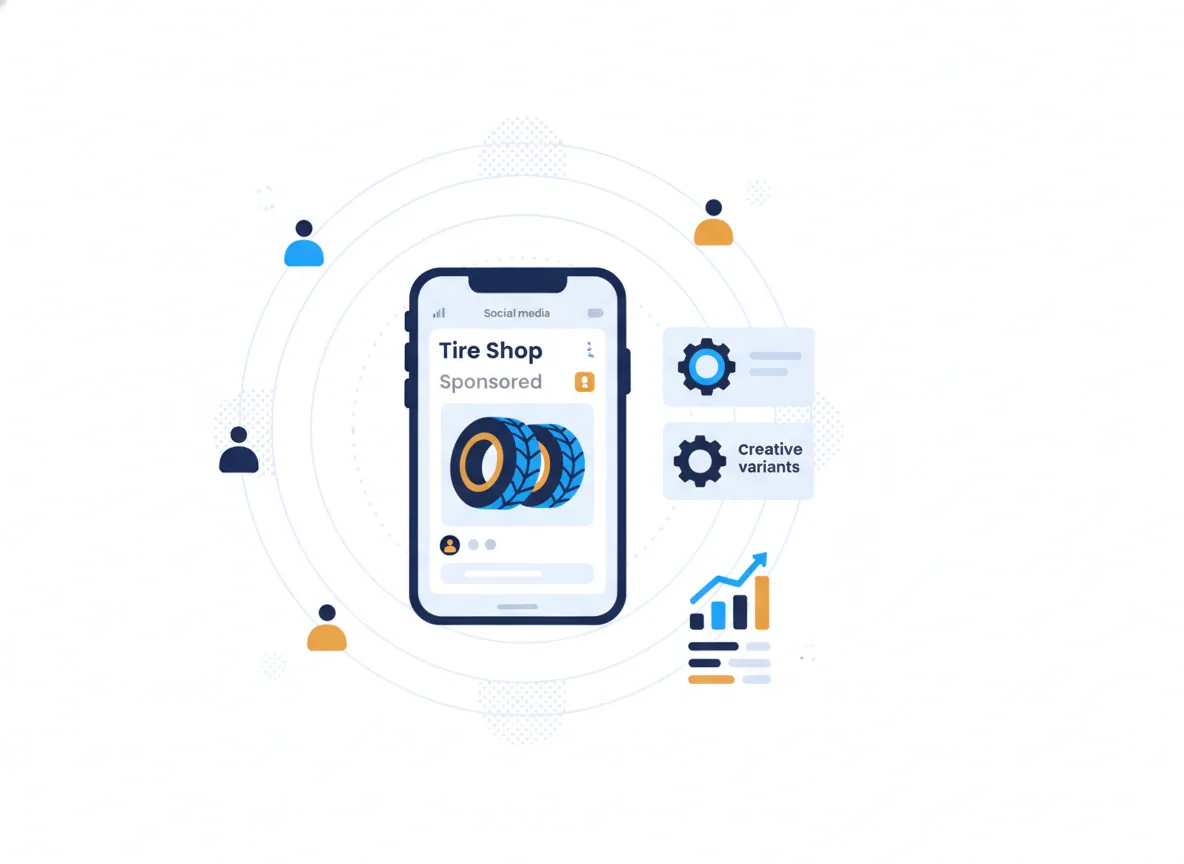
A basic Meta Ads campaign for a local tire repair shop usually starts around $1,000 to $2,500 a month in ad spend, plus a management fee if you hire a marketing agency. Your actual cost per booked job will depend heavily on your local market density, the competition in your area, and the specific automotive services you promote.
Running profitable ads requires understanding exactly where your money goes and holding your campaigns accountable to actual revenue. Too many shop owners throw money at social media without tracking the return. A strategic tire repair meta ads investment separates your media budget from your management costs so you can track precisely what it costs to get a vehicle onto your lift.
The Core Components of Your Tire Repair Meta Ads Investment
When you look at the total cost of running ads on Facebook and Instagram, your expenses break down into three distinct categories. You need to fund the platform, build the assets, and manage the strategy. Blurring these lines is exactly how auto shops lose track of their return on investment.
Ad Spend (The Money Paid to Meta)
This is the money you pay directly to Meta to show your ads to local drivers. It serves as your primary media budget. Every time someone sees or clicks your ad, Meta deducts a fraction of a cent or a few dollars from this pool. For a single-location tire shop, a functional daily budget usually sits between thirty and eighty dollars. Spending less than this starves the machine learning algorithm of the data it needs to find people who actually want to book an appointment.
Agency Management Fees
If you hire a marketing agency to run your digital marketing for tire repair, you will pay a management fee. This compensates the team for writing the ads, designing the graphics, managing the daily bids, and optimizing the overall campaign. Management fees are typically billed as a flat monthly rate or a percentage of your total ad spend. Flat rates are generally better for auto shops because they do not financially incentivize the agency to unnecessarily increase your ad spend just to inflate their own fee.
Creative and Setup Costs
Before an ad ever goes live, you need tracking pixels installed on your website, landing pages built, and ad creatives designed. Some agencies charge a one-time onboarding fee to handle this technical heavy lifting. Proper setup is non-negotiable. If your tracking is broken, you will never know which ads are actually driving tire sales and which are just burning cash.
What a Standard Monthly Budget Looks Like
Budgeting requires a realistic look at your local market density. If your shop is in a highly populated urban area with a dozen direct competitors within a five-mile radius, you will need a higher ad spend just to stand out in the feed. If you operate in a suburban or rural area, you can often dominate local timelines with a smaller budget.
A sensible starting point for a single-location tire repair shop includes roughly fifteen hundred dollars allocated directly to Meta for ad spend. This gives the platform enough runway to test different messages, like promoting winter tire changeovers versus pothole damage alignments. You then factor in the management fee on top of that. A campaign funded with too little ad spend will inevitably fail, even if the ads themselves are perfectly designed, because they simply will not reach a critical mass of local drivers.
Tracking Cost Per Customer Acquisition
Impressions, clicks, and page likes do not pay your mechanics. The only metric that truly matters is your cost per booked job. Tire repair customer acquisition hinges on knowing exactly how much you spend to acquire a paying customer.
If you spend one thousand dollars on Meta Ads in a single month and generate twenty booked appointments, your cost per acquisition is fifty dollars. You must then compare this against your average repair order. If a customer comes in for a simple twenty-dollar patch, that fifty-dollar acquisition cost eats your entire margin and puts you in the red. However, if that same campaign brings in customers buying full sets of premium tires and scheduling four-wheel alignments, a fifty-dollar acquisition cost is highly profitable and sustainable.
Your marketing partner must provide transparent billing and clear reporting on these metrics. You need to see the exact relationship between the marketing dollars leaving your account and the service revenue entering your shop.
Where Tire Repair Campaigns Typically Go Wrong
Many shop owners try running their own ads before hiring a professional. The social media platforms are deliberately designed to make spending money easy, but generating a tangible return is difficult. Here is where the budget usually bleeds out.
Relying on the Boost Button
Meta routinely prompts you to boost posts directly from your business page. Hitting that button is the absolute fastest way to waste your marketing budget. Boosted posts are optimized purely for engagement, meaning Meta will show the post to people likely to like or comment on it. Likes do not sell tires. Proper Meta Ads are built in the complex Ads Manager backend and optimized specifically for conversions, targeting drivers who are likely to click through and schedule a service.
Poor Audience Targeting
Tire repair is a hyper-local, necessity-based business. Nobody is driving two hours just to fix a flat tire. If your location targeting is set too wide, you end up paying to show ads to people who will never realistically visit your shop. You also waste money if you fail to exclude your existing employees or people who literally just bought a set of tires from you last week.
Hidden Agency Fees and Vanity Metrics
Some marketing providers bundle the ad spend and their management fee into one murky, combined invoice. You never know exactly how much went to Meta and how much the agency pocketed for themselves. This total lack of transparency hides marketing waste. Additionally, agencies masking poor performance will constantly highlight vanity metrics like reach and impressions instead of focusing on actual tire repair customer acquisition. Always demand strict separation between ad spend and management fees.
Dropping Traffic on a Generic Homepage
When a driver clicks an ad promoting a specific alignment special, they immediately expect to land on a page talking about that exact alignment special. If your ad drops them onto your generic homepage where they have to hunt for the offer and figure out how to call you, they will leave and call the shop down the street. Every single ad needs a dedicated landing page designed specifically to convert that exact traffic into a booked appointment.
How to Scale Tire Repair Online with Meta Ads
Once you establish a profitable baseline cost per acquisition, you can begin to scale tire repair online. Scaling does not just mean blindly increasing the daily budget. It means identifying the most profitable campaigns and strategically shifting funds toward them.
For example, you might find that ads targeting sudden flat tire repairs have a high conversion rate but low overall ticket revenue, while ads targeting scheduled preventative maintenance have a higher acquisition cost but bring in massive repair orders. Scaling involves running dedicated campaigns for high-ticket services like complex suspension work, comprehensive brake repairs, and premium tire packages to maximize the total return on your ad spend.
You can also scale efficiently by introducing retargeting campaigns. Retargeting shows specific ads to people who visited your website but did not book an appointment. These ads are incredibly cheap to run because the audience is highly targeted, very small, and already familiar with your auto shop. A simple reminder ad offering a slight discount or highlighting your easy online booking portal can capture customers who just needed a little more time to make a decision.
Eliminating Marketing Waste in Your Ad Spend
Eliminating waste requires strict asset tracking and continuous, rigorous testing. Every element of your campaign should earn its keep. If a specific image of your mechanics working in the bay outperforms a generic stock photo of a tire, you turn off the stock photo ad and immediately reallocate that budget to the winning creative.
Your marketing partner should execute high-efficiency strategies that focus heavily on eliminating dead weight. This means regularly reviewing search intent, adjusting geographic radius targeting based on where your best customers actually live, and pausing ads that generate expensive clicks but zero phone calls. Transparent, scalable billing profiles allow you to see exactly which specific initiatives are driving real growth.
You must also closely monitor the quality of the incoming leads. If your ads generate a high volume of calls from people looking for cheap, used tires, and your shop only sells brand new premium brands, your targeting is fundamentally flawed. You are paying for leads that you cannot service. Refining the ad copy to explicitly state that you sell new premium tires filters out unqualified buyers before they cost you a click.
Making Your Campaign Profitable Long-Term
Achieving massive profitability with Meta Ads is not an overnight process. The platform heavily relies on machine learning, which means the algorithms need time and data to figure out who your ideal customer actually is. The first few weeks of any new campaign are strictly a learning phase. You are buying data just as much as you are buying initial leads.
As the campaign matures and gathers data, your cost per acquisition should stabilize and eventually decrease as the audience targeting becomes more precise. The real key to long-term success is consistency. Pausing your ads every time the shop gets a little busy and restarting them when things slow down forces the algorithm to start the learning process over from scratch every single time.
A consistent Meta Ads strategy builds a highly predictable pipeline of local customers. By focusing heavily on transparent financial metrics, demanding complete accountability for every dollar spent, and partnering with a digital team that tracks actual booked jobs, you can turn your digital marketing into a highly reliable engine for steady growth.

 By Chris Lee