

Meta Ads
Breaking Down the Real Financial Cost of Tire Repair Meta Ads
Understand the true financial costs of running Meta Ads for your tire repair shop, from daily ad spend to agency fees and customer acquisition tracking.
8 min read
Meta Ads
 By Chris Lee9 min read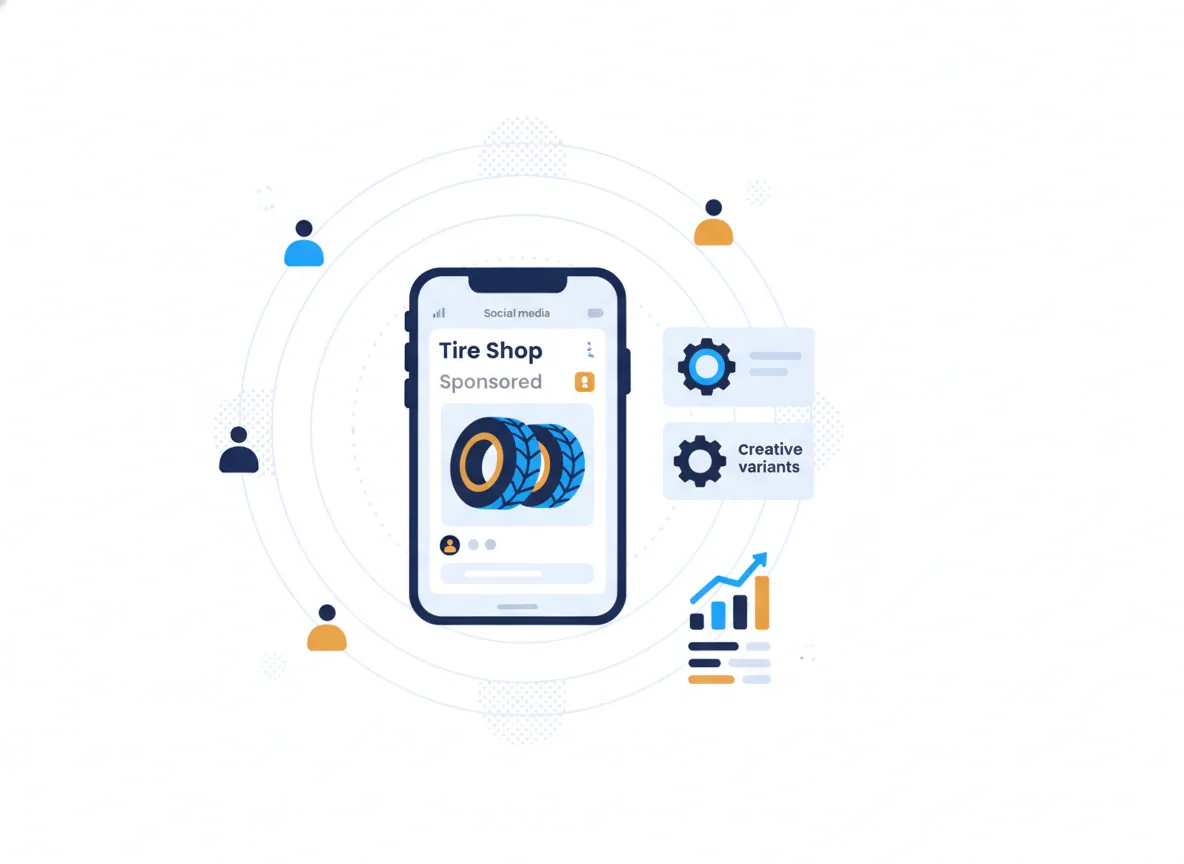
The secret to a high-converting Meta Ads campaign for your auto shop is hyper-local targeting paired with frictionless lead capture. You need to show up in local feeds with a clear offer and make it effortless for drivers to book a bay. Relying on broad targeting and a basic link to your homepage wastes your ad spend and fills your dashboard with cheap clicks that never turn into actual repair tickets.
This strategic operational playbook breaks down exactly how to structure your campaigns. By focusing on proprietary methodologies in user behavior mapping, custom audience segmentation, and automated lead capture, you can turn passive scrollers into paying customers. Here is how to configure your Meta Ads to fill your schedule.
People use Meta platforms to be entertained or to connect with friends, not to search for emergency auto repair. Understanding this user behavior mapping is the foundation of any successful digital marketing for tire repair. If someone hits a pothole and blows out a tire, they go to a search engine. Meta Ads serve a different purpose: they capture latent demand and drive preventative maintenance decisions.
Your audience on Facebook and Instagram is scrolling passively. To interrupt that scroll, your ad must address a common, recognizable problem or present an offer they cannot ignore. Think about the friction points of tire repair. It is expensive, time-consuming, and confusing for the average driver. Your ads need to dismantle those friction points immediately.
Address seasonal tire wear. Highlight the dangers of bald tires before winter weather hits. Promote alignment checks after major road construction projects in your city. By mapping the specific, timely reasons a driver might need your services, you move away from generic "we fix tires" messaging and toward compelling, situation-specific hooks that command attention.
Proper targeting dictates whether your ads are seen by viable local prospects or people hundreds of miles away. Effective custom audience segmentation configurations keep your ads focused entirely on the drivers who can realistically pull into your lot.
Local auto shops live and die by their geographic radius. Drivers rarely cross town or sit in heavy traffic for a standard tire rotation unless you offer a highly specialized service. Restrict your targeting to a tight radius around your shop. Depending on your local density, this might be a three-mile radius in a major city or a ten-mile radius in a suburban area.
Use zip code targeting if certain neighborhoods naturally route traffic past your shop. Exclude zip codes that require crossing major geographic barriers like toll bridges or heavy traffic corridors, as people are statistically less likely to make that trip for standard maintenance.
Your shop's point-of-sale system or CRM is a goldmine for Meta Ads targeting. Export a list of customers who bought tires from you three or four years ago. Upload this list to Meta as a custom audience. These individuals are prime candidates for a new set of tires, and because they already trust your firm, your conversion rate will be substantially higher.
You can also create lookalike audiences based on your best existing customers. Meta will analyze the data points of the people who already spend money at your shop and find other local users with similar behaviors and demographics. This is a highly effective way to expand your reach without sacrificing quality.
A click on your ad is useless if you do not have a system to capture the contact information and turn it into a booked appointment. Building automated lead capturing cascades ensures that no prospect falls through the cracks between clicking your ad and talking to your service writer.
You have two primary options for capturing information on Meta: native lead generation forms or external landing pages. Native lead forms keep the user inside the Facebook or Instagram app. They load instantly, and Meta auto-fills the user's name, email, and phone number. This drastically lowers the friction of conversion, leading to a higher volume of leads.
However, native forms can sometimes produce lower-intent leads because they are so easy to submit. If you choose this route, add one custom question, such as "What is the year, make, and model of your vehicle?" This forces the user to stop and type, filtering out accidental clicks.
If you use an external landing page, it must be ruthlessly optimized for mobile devices. Over eighty percent of your ad traffic will come from smartphones. The page must load in under two seconds. It needs a massive, thumb-friendly button to call your shop directly. Remove all navigation menus, external links, and distractions. The only options should be to call the shop or fill out a short booking form.
Speed to lead is the most critical factor in tire repair customer acquisition. If a user submits a lead form at noon, and your service desk calls them at four o'clock, they have likely already called another shop. You need an automated system that bridges the gap between Meta and your front desk.
Set up an integration using a tool like Zapier. The moment a lead form is submitted, the system should trigger three actions:
This automated cascade removes the burden of manual tracking from your busy staff while ensuring every single advertising dollar is maximized.
The visual component of your ad is what stops the scroll. If your creative looks like an advertisement, people will swipe past it. To win on Meta, your ads need to look like native, organic content that belongs in the feed.
Never use stock photos of pristine, perfectly clean mechanics smiling under a car. Consumers are blind to these images. Instead, use real photos of your actual shop, your actual team, and real vehicles in your bays. Authenticity builds instant trust.
Take a smartphone photo of a technician balancing a tire, operating the alignment machine, or showing the difference between a bald tire and a brand-new one. Rough, unpolished, well-lit photos outperform slick, highly produced graphics almost every time because they prove you are a real business operating in the user's community.
Your ad copy must get straight to the point. State exactly what you are offering and why they should care. Are you offering a discount on a set of four tires? Free alignment checks with every rotation? Put the offer in the very first line of the primary text.
Use short, punchy sentences. Break up paragraphs so they are easy to read on a small screen. Include a clear call to action at the bottom of the text telling them exactly what to do next, whether that is tapping the image to claim a voucher or calling the number on the screen to book a bay.
Budgeting for Meta Ads requires a strategic approach. You cannot throw a few dollars at a campaign and expect a flood of new customers. You must structure your tire repair Meta Ads investment to feed the algorithm enough data to optimize delivery.
Meta's algorithm operates on a learning phase. To exit this phase and stabilize your costs, the system generally needs to see around fifty conversion events within a seven-day window. A conversion event might be a submitted lead form or a clicked call button.
If you set your daily budget too low, you will never achieve enough volume to exit the learning phase. The campaign will remain volatile, and your cost per lead will fluctuate wildly. Set a starting daily budget that allows for continuous testing. Focus on cost per booked job rather than just cost per click. A more expensive click that actually turns into a four-hundred-dollar tire replacement is far more valuable than fifty cheap clicks that do nothing.
Once you identify which audiences and creatives yield the lowest cost per booked appointment, you can begin reallocating your budget. Shift funds away from underperforming ads and consolidate your daily spend into the winning variations. Expect this optimization process to take at least a full month before you see stabilized, predictable returns.
Many auto shops attempt to run Meta Ads, burn through their budget in a few weeks, and declare that the platform does not work. This failure is almost always the result of a few predictable, operational errors.
Relying on the Boost Post Button: Hitting "Boost" on a Facebook post is not running a strategic ad campaign. Boosting a post optimizes for vanity metrics like likes, comments, and shares. It does not optimize for leads or booked appointments. Always build your campaigns inside the Meta Ads Manager, where you have full control over objectives, placements, and lead tracking.
Sending Traffic to the Homepage: As mentioned earlier, directing ad clicks to your main website URL introduces too much friction. The user has to hunt for the phone number, navigate through your service menus, and figure out how to book. They will not do it. Always use dedicated landing pages tied directly to the specific offer in the ad.
Ignoring Form Fatigue: Ad creatives burn out quickly on local audiences. Because your geographic radius is small, the same users will see your ad multiple times a week. After a while, they stop noticing it entirely. This is called ad fatigue. You must refresh your images, videos, and ad copy regularly to keep the campaign active and engaging.
Once your baseline lead generation campaign is functioning and profitable, you can begin to scale tire repair online using more advanced tactics. Scaling does not just mean increasing the budget; it means expanding your strategies to capture different segments of the market.
Implement aggressive retargeting campaigns. If a user clicks your ad, visits your landing page, but does not submit their information, they should immediately begin seeing your ads everywhere they go on Facebook and Instagram. Retargeting ads are typically cheaper to run and boast much higher conversion rates because the user is already familiar with your brand.
You can also scale by aligning your ad copy with specific seasonal pushes. Run dedicated campaigns for winter tire changeovers in the late fall. Pivot to pothole damage and alignment specials in the spring. By keeping your messaging highly relevant to the immediate realities of local driving conditions, you maintain a high click-through rate year-round.
Tracking your outcomes meticulously is the final piece of the puzzle. Connect your Meta Ads data back to your shop management system. Knowing exactly which ad resulted in a multi-vehicle fleet account versus a simple flat tire patch allows you to assign a true return on investment to your marketing efforts. Stick to the mechanics of the playbook, measure your cost per booked job closely, and let the data guide your next operational move.
You should start with a daily budget that allows the algorithm to exit the learning phase, typically requiring fifty conversion events per week. For most local tire shops, this means an initial monthly baseline between one thousand and two thousand dollars. Spending less throttles your reach and prevents you from gathering actionable data.
Single-image ads and short video reels showing real mechanics working in your actual service bays perform best. Carousel ads also work well for highlighting specific tire brands or seasonal maintenance packages. Avoid stock photos entirely, as users scroll right past them in favor of authentic local content.
Expect it to take three to four weeks to see a consistent, predictable flow of reliable leads. The first two weeks involve the learning phase, where Meta tests your targeting and creatives against the local market. By month two, you can begin optimizing for a lower cost per booked appointment.
Your landing page or automated lead capturing cascade is likely broken, slow, or irrelevant. If users click an ad for a specific tire alignment special but land on your generic homepage, they will leave. You need a dedicated, mobile-optimized landing page with a single, clear button to call or book immediately.
Keep reading
Meta Ads
Understand the true financial costs of running Meta Ads for your tire repair shop, from daily ad spend to agency fees and customer acquisition tracking.

Meta Ads
Turn local scrollers into scheduled repair jobs with this operational Meta Ads playbook. Discover targeting setups and automated lead cascades built specifically for mechanics.
Meta Ads
Stop guessing what mechanic Meta Ads should cost. Learn how to budget for ad spend, avoid hidden agency fees, and calculate your true cost per booked repair.
Find out how we can help your business succeed.
Free audit of your market, your competitors and the gap between them.
Free audit · No obligation · No long-term contract