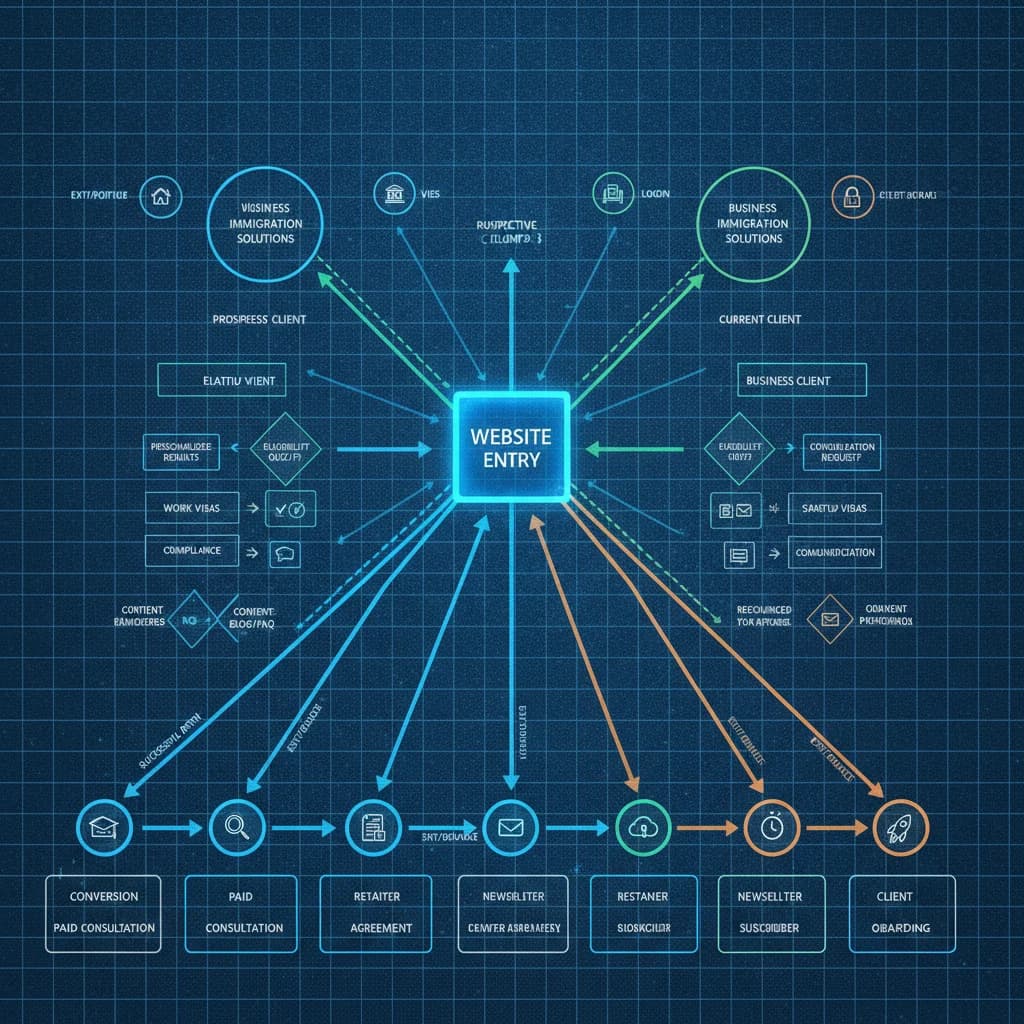
A professionally built immigration law website generally costs between $3,000 and $15,000 for a one-time custom build, or between $500 and $2,500 per month on a managed service model. Your total immigration law website services investment depends directly on your firm's operational complexity, the depth of your practice areas, and the specific conversion tools integrated into your digital infrastructure.
Many managing partners treat website design as a generic administrative expense. That is a costly mistake. For an immigration practice, your website serves as your primary intake coordinator, your vetting engine, and your principal conversion channel. Whether your firm handles family-based adjustments of status, complex deportation defense, or corporate employment visas, prospective clients inspect your digital presence to evaluate your competence before booking a consultation. Understanding market rates, asset ownership, and return on investment helps you allocate marketing capital effectively.
Baseline Cost Ranges for Immigration Law Websites
Legal web design projects fall into three primary pricing tiers based on development scope, custom functionality, and strategic depth.
Basic Template Deployments ($1,500 to $3,000)
Entry-level sites are built using pre-made themes on generic website builders. These sites feature standard contact pages, a basic contact form, and a handful of surface-level practice area overviews. While affordable for a newly licensed solo practitioner, template builds lack custom conversion paths, proper schema markup, and advanced intake integrations. They often struggle to rank in competitive metropolitan legal markets.
Custom Immigration Law Practice Sites ($4,000 to $9,000)
This mid-tier range represents the industry standard for established solo attorneys and boutique partnerships. A custom build in this category includes dedicated landing pages for specific visa categories, bilingual or multilingual architecture, CRM connectivity, and mobile-first performance engineering. Firms investing in this tier receive custom graphic design, clear brand positioning, and structured on-page search optimization tailored to regional search queries.
Enterprise and Multi-Location Platforms ($10,000 to $20,000+)
Large immigration practices with multiple regional offices, large associate teams, or high-volume corporate immigration departments require enterprise-grade digital infrastructure. These platforms feature deep content silos covering hundreds of immigration legal scenarios, custom client portal integrations, real-time consultation scheduling engines, automated document intake workflows, and advanced tracking dashboards. These systems require extensive development hours and comprehensive security protocols.
If you prefer an ongoing partnership rather than a large upfront capital outlay, exploring dedicated professional website services provides access to enterprise-grade web development paired with continuous technical maintenance and ongoing optimization.
Core Features That Drive Project Pricing
Immigration law websites require specific technical elements that generic corporate websites do not need. These unique legal requirements directly impact your development costs.
Multilingual Architecture and Localization
Immigration practices frequently serve communities whose primary language is not English. Installing a generic automated translation widget does not solve this problem. Automated widgets often misinterpret precise statutory terms, alienating readers and damaging your credibility. True localization requires clean subdirectory or subdomain architecture, localized metadata, and professionally drafted legal content in Spanish, Portuguese, French, Vietnamese, or Mandarin. Structuring multiple localized versions of your site adds development and copywriting hours, but it dramatically expands your local market reach.
Integrated Intake and Consultation Scheduling
Directing prospective clients to a static contact box leads to lost opportunities. High-performing legal websites incorporate automated pre-screening forms that route inquiries based on case type, urgency, and filing deadlines. Integrating these intake flows directly into legal practice management platforms like Clio, MyCase, or LawPay eliminates manual data entry for your paralegals. Designing conditional logic into your intake forms increases project scope while substantially lowering your administrative overhead per case.
Mobile Optimization and Accessibility
A substantial portion of individuals seeking family-based immigration assistance or removal defense access the web exclusively through mobile devices. If your site features slow loading speeds, unreadable legal disclaimers, or clumsy mobile navigation, users will leave immediately to visit a competitor. Engineering lightning-fast mobile speeds, compliant touch elements, and ADA-compliant accessibility features requires clean, lightweight coding practices.
Addressing these fundamental architectural requirements is a critical step when implementing broader strategies for scaling your immigration firm in competitive jurisdictions.
Transparent Billing vs. Hidden Retainer Fees
The legal marketing sector contains significant pricing discrepancies. Some agencies quote low upfront design fees only to trap firm owners inside opaque long-term contracts. Evaluating marketing proposals requires looking closely at how agencies structure their fees.
The Proprietary CMS Trap
Certain legal marketing vendors build your site on proprietary, closed-source content management systems. Under this model, your firm pays a continuous monthly fee to lease the site. If you decide to cancel the contract, the agency deletes your website, and you leave with nothing. You do not own the code, the design, or the landing pages you spent years paying to promote. Always ensure your firm retains full ownership of your domain, your content, and an open-source codebase like WordPress.
Hidden Management Surcharges
Agencies frequently bundle web maintenance with generic marketing packages. These retainers may include obscure fees for routine software updates, simple text revisions, or basic analytics reporting. Transparent agencies operate with clear, line-item billing. You should always know exactly how much capital supports hosting and security, how much supports new development, and how much is directed toward active promotion.
Before signing a multi-year retainer with an agency, take time to compare how established legal marketing agencies package their services and bill their clients.
What Typically Goes Wrong with Legal Website Projects
Immigration website redesigns frequently fail to produce results. Understanding common pitfalls helps protect your firm's capital.
Generic, Outdated Legal Copy
The most common failure point is purchasing generic legal content packages. Boilerplate summaries of H-1B visas or naturalization requirements that read like government manuals do not persuade a stressed individual to hire your firm. Prospective clients want to know how your team approaches difficult USCIS delays, requests for evidence, or deportation proceedings. If your agency uses non-legal copywriters who recycle identical text across multiple law firm clients, your search visibility and conversion rates will suffer.
Treating the Site as an Electronic Brochure
An immigration website should function as an active client acquisition asset, not an electronic business card. Many web designers focus entirely on visual aesthetics while ignoring conversion paths, call-to-action placement, and localized search signals. A visually pleasing website that receives zero organic traffic or fails to direct visitors toward booking a paid consultation represents stranded capital.
Failing to Plan for Regular Statutory Changes
Immigration policy shifts rapidly through executive actions, administrative policy memos, and court rulings. Websites built on rigid, hard-coded structures make updating practice guidelines and fee schedules difficult and expensive. Your site must be engineered with a flexible content management framework that allows your staff to publish timely legal updates without incurring billable agency developer hours every week.
Avoiding these operational mistakes allows you to execute successful digital marketing for immigration law that consistently attracts qualified prospective clients.
Calculating ROI and Immigration Law Customer Acquisition
Determining whether a website build makes financial sense requires evaluating your firm's case economics against your investment.
The Lifetime Value of a Retained Matter
Immigration practice areas carry diverse revenue profiles. A simple naturalization case may generate modest legal fees, whereas an EB-5 investor visa, an employment PERM certification, or a protracted removal defense proceeding yields substantial revenue. To calculate return on investment, identify your average gross fee per retained case and your average conversion rate from initial inquiry to signed retainer.
The Break-Even Formula
Consider a practical scenario. Suppose your firm invests $7,500 into a custom, conversion-focused website build, plus $300 monthly for hosting and maintenance. Your annual digital asset expense for year one totals $11,100.
- If your average retained case fee across family and removal cases is $4,000, your firm must retain just three additional clients across the entire year to break even on the development cost.
- If your firm focuses on corporate immigration or investor visas with average case values exceeding $8,000, retaining two additional corporate clients covers your website costs and generates an immediate cash profit.
Because legal websites remain active digital assets for three to five years before requiring a major overhaul, your return on investment accelerates substantially in years two and three, when your ongoing costs are limited to standard maintenance.
Lowering Customer Acquisition Costs
A high-converting website directly reduces your long-term immigration law customer acquisition costs. When your site converts a higher percentage of visitors into booked consultations, every dollar you spend on paid search campaigns, local business directories, or content marketing delivers higher returns. Investing in clear value propositions, transparent attorney profiles, and friction-free intake workflows turns baseline web traffic into reliable monthly revenue.
Building a Digital Asset to Scale Your Immigration Practice
A modern immigration law firm cannot rely solely on courthouse referrals or word-of-mouth recommendations to achieve sustainable growth. Prospective clients search online under stressful conditions, seeking authoritative, reassuring legal counsel. Providing them with an accessible, multilingual, and fast-loading web experience establishes credibility before they ever speak with your intake team.
Treat your website design as a long-term capital investment rather than an administrative line item. By insisting on clear asset ownership, measurable conversion tracking, and transparent vendor billing, you eliminate wasted marketing spend and position your practice to scale immigration law online systematically.

 By Kayce Marty