Immigration website visitors convert when your site reduces anxiety, communicates in their native language, and directs them to an immediate, frictionless intake pathway. Most immigration practice sites fail to generate booked consultations because they present static walls of legal statute instead of guiding users through an empathetic, category-specific evaluation based on their urgent legal needs.
Building a high-converting immigration practice requires treating your website as an operational intake filter rather than a digital brochure. Prospective clients searching for legal relief are often stressed, operating under strict deadlines, or navigating complex corporate visa requirements. To turn these visitors into retained cases, your online presence needs structured blueprints that account for distinct user behaviors, automated triage pathways, and precise audience segmentation.
User Behavior Mapping for Immigration Practice Areas
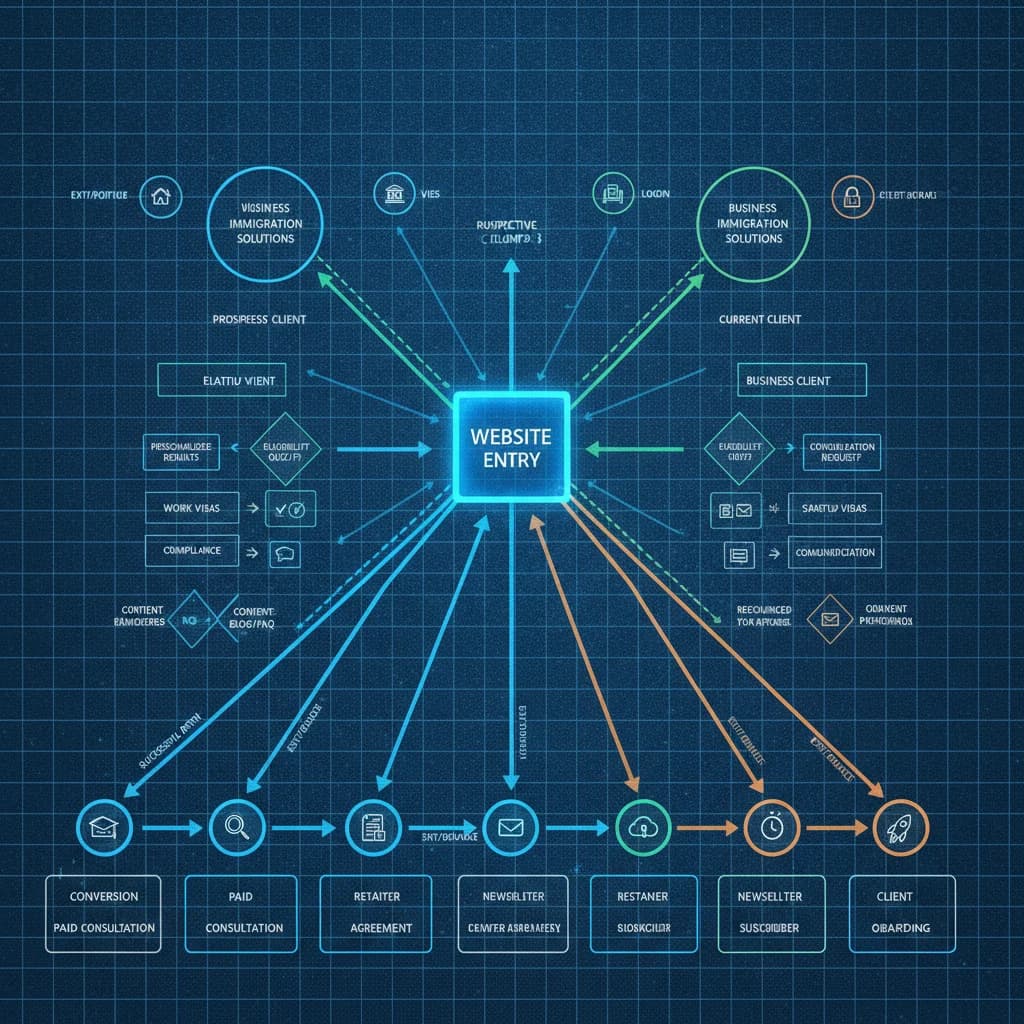
Visitors do not arrive at an immigration law website with the same intentions, emotional states, or technical capabilities. Treating an individual facing deportation proceedings the same as an HR director managing H-1B transfers damages conversion rates across both audiences. Effective user behavior mapping separates your website traffic into distinct user journeys before they ever reach a consultation form.
The Crisis Profile: Removal Defense and Urgent Petitions
Users searching for deportation defense, bond hearings, or emergency stays are in acute distress. They read very little body copy. Instead, they scan for reassurance, physical location, availability, and an instant line of communication. For this profile, your website must prioritize tap-to-call buttons, emergency consultation triggers, and visible language selectors directly in the header. Forcing these users to scroll past lengthy firm histories causes immediate abandonment to a competitor who offers an immediate phone connection.
The Family Petitions Profile: Adjustment of Status and Consular Processing
Spouses, parents, and relatives seeking green cards or naturalization exhibit high-deliberation behavior. They research timelines, processing stages, and documentation requirements. These visitors consume educational resources, review processing roadmaps, and assess attorney credibility through clear fee structures and case experience. Their conversion trigger is rarely an immediate phone call; it is an interactive eligibility screener or a clear, scheduled calendar booking that lets them plan their family finances.
The Corporate and Investor Profile: Employment Visas and Compliance
Corporate managers, foreign professionals, and investors seeking O-1, L-1, or EB-5 visas evaluate polish, institutional competence, and business fluency. They look for industry familiarity, corporate client processes, and streamlined retainer agreements. These visitors respond best to white-glove contact forms, direct calendar integration with legal staff, and downloadable compliance checklists. Investing in structured professional website design services ensures these distinct pathways exist side-by-side without confusing or alienating either client base.
Automated Lead Capturing Cascades
Static contact forms that ask for a name, email, phone number, and a blank "message" box depress conversion rates and flood your office with unqualified leads. High-performing practices deploy automated lead capturing cascades that capture commitment incrementally while qualifying the prospect in real time.
A successful cascade breaks the intake process into four operational stages:
- Low-Friction Categorization: The user begins by selecting their primary concern via visual cards (e.g., "Family Petition," "Asylum / Removal," "Employment Visa," or "Citizenship"). This micro-commitment requires zero personal information and reassures the visitor that they are in the right place.
- Case Qualification Logic: The form branches based on the selection. If the user selects employment visas, it asks for the current employer status or petitioner location. If they select family immigration, it asks who they are petitioning for. This prevents tire-kickers while gathering essential case context.
- Contact Collection: Once the prospect invests effort into answering three or four non-invasive questions, the form asks for their name, phone number, and email to deliver their initial consultation options. Drop-off rates drop significantly when contact fields appear after the user sees value.
- Immediate Next-Step Routing: High-intent matters route to live appointment booking software. Lower-priority or pro bono inquiries receive automated intake questionnaires or referral partner links. This protects your team's billable time while reducing the overall cost of optimizing marketing budgets for high-intent leads.
Implementing automated cascades ensures your legal intake team stops spending hours chasing dead ends. By integrating these forms directly with your law practice management software or CRM, contact data triggers automated SMS and email confirmations within seconds of submission.
Custom Audience Segmentation Configurations
Sending all incoming web traffic to your homepage is a guaranteed way to drive up customer acquisition costs. Effective strategies for scaling an immigration firm rely on tailoring the landing environment to the exact intent and traffic channel of the visitor.
When running targeted campaigns, your website architecture must segment users across three fundamental layers:
- Traffic Channel Alignment: Visitors arriving from Google Search ads are searching for immediate solutions to precise queries (e.g., "marriage green card lawyer near me"). They need dedicated, stripped-down landing pages devoid of main navigation links, focused solely on the marital adjustment process. Visitors from social platforms, by contrast, are earlier in their research cycle and need educational content, video explanations, and downloadable guides.
- Language Localization Beyond Machine Translation: Browser-based auto-translation tools frequently butcher legal terms of art, destroying trust with immigrant communities. True segmentation requires dedicated subdirectories (such as /es/ for Spanish or /pt/ for Portuguese) with human-reviewed legal copy, culturally attuned imagery, and intake forms configured to route directly to bilingual intake specialists.
- Geographic and Jurisdictional Routing: Immigration law is federal, but client preference is deeply local. Segmenting landing pages by metropolitan area, field office, or immigration court jurisdiction builds hyper-local authority that generic national legal portals cannot match.
Aligning your digital marketing for immigration law with targeted website architecture ensures that ad spend generates consultations rather than immediate bounces.
What Typically Goes Wrong on Immigration Law Websites
Even well-funded immigration practices routinely make structural website errors that quietly drain their conversion pipelines. Identifying these operational failures helps prevent wasted ad spend and lost cases.
Overwhelming the User with Legal Disclaimers
Legal ethics rules require clear disclaimers that visiting a website does not establish an attorney-client relationship. However, many firms position massive, frightening disclaimers directly inside or above their contact forms. Placing aggressive legal warnings before a lead has even submitted their information spikes abandonment. Place compliance disclaimers cleanly in form subtext or footers, keeping the primary focus on the consultation offer.
Relying Exclusively on Email Forms
A significant portion of immigration clients prefer messaging apps or direct phone calls over email. In many immigrant communities, WhatsApp is the default communication standard. Firms that only offer a desktop-oriented email form lose prospective clients to competitors who offer direct WhatsApp messaging buttons, live chat widgets, and click-to-call mobile prompts.
Ignoring Mobile Page Speed
Prospective immigration clients frequently browse on mid-range mobile devices connected to cellular data. If your website takes four seconds to load uncompressed stock images and third-party tracking scripts, the visitor hits the back button. Speed is a baseline conversion metric; every second of delay directly reduces form completions.
Unresponsive Intake Follow-Up
The best website blueprint fails if your intake workflow is sluggish. Immigration prospects typically contact three to five firms in a single sitting. If your website collects a lead but your office takes four hours to send an automated response, that prospect has already scheduled a consultation elsewhere. The website must connect directly to automated SMS auto-responders that confirm receipt and provide calendar scheduling links immediately.
The Economics of Immigration Law Website Services Investment
Investing in your firm's digital infrastructure requires a clear understanding of costs, development scope, and realistic payback horizons. A successful immigration law website services investment is an asset that yields measurable returns, but cutting corners early creates expensive technical debt later.
A barebones template site built on a basic content management system can cost between $1,500 and $3,500. While cheap upfront, these sites lack custom intake branching, bilingual architecture, and CRM integration. They often require manual data entry by your staff, which quietly costs thousands of dollars in lost administrative hours over a year.
A fully custom, conversion-engineered immigration platform generally ranges from $5,000 to $15,000 upfront. This level of investment includes custom interactive intake cascades, native multilingual translation setups, speed optimization, and direct API routing to practice management platforms like Clio, Lead Docket, or Lawmatics. Ongoing technical maintenance, hosting, conversion rate testing, and landing page refinement typically require $300 to $1,000 per month.
When evaluating this expenditure, evaluate your firm's customer acquisition metrics:
- Average Case Value: Determine the lifetime value of an adjustment of status, asylum defense, or corporate petition. Often, acquiring just one or two additional retained clients each month completely offsets the cost of a top-tier website build.
- Time-to-Payback: Expect a development and deployment cycle of six to ten weeks, followed by an operational testing period of 60 to 90 days to gather sufficient traffic data. Realistic payback schedules sit between four and six months from launch.
- Agency Selection Tradeoffs: When evaluating partners to build your digital infrastructure, study how agencies structure their technical deliverables. Taking the time to compare immigration legal marketing agencies prevents you from buying proprietary closed platforms that trap your firm's data.
Firms that commit to a dedicated technical platform create predictable avenues to scale immigration law online without adding proportional administrative overhead.
The Operational Conversion Blueprint Checklist
Use this operational checklist to evaluate whether your current website infrastructure is built to support sustainable immigration law customer acquisition or if it is actively leaking leads.
1. Core User Interface and Mobile Usability
- Does the mobile layout present an immediate, tap-to-call phone number and language toggle in the sticky top header?
- Is body copy readable on small screens without zooming, utilizing high-contrast typography?
- Are team biographies accompanied by clear credentials, languages spoken, and bar admissions to establish immediate trust?
2. Intake Architecture and Form Mechanics
- Are general contact forms replaced with short, multi-step eligibility cascades?
- Does the intake questionnaire branch dynamically based on whether the case is family, humanitarian, or employment-based?
- Are input fields limited to essential qualifying data on the first screen?
- Does the form provide instant feedback upon submission, including a direct calendar link to schedule a consultation?
3. Technical Foundation and Compliance
- Does the site achieve strong mobile performance scores with under two-second load times on cellular connections?
- Are translations managed via dedicated language subdirectories rather than broken browser widgets?
- Is all lead data encrypted in transit using SSL certificates and submitted securely into HIPAA- and legal-compliant databases?
Turning an underperforming immigration site into a client acquisition engine requires systematic execution. Review your operational intake flow, eliminate friction points for anxious clients, and collaborate with specialists who understand how to build systems on our agency home page to secure sustainable firm growth.

 By Kayce Marty