
 By Chris Lee
Meta Ads
Proven Massage Therapy Meta Ads Blueprints for Accelerating Growth
Stop wasting ad spend. Use this operational playbook to build Meta Ads campaigns that drive booked massage appointments directly to your calendar.
9 min read
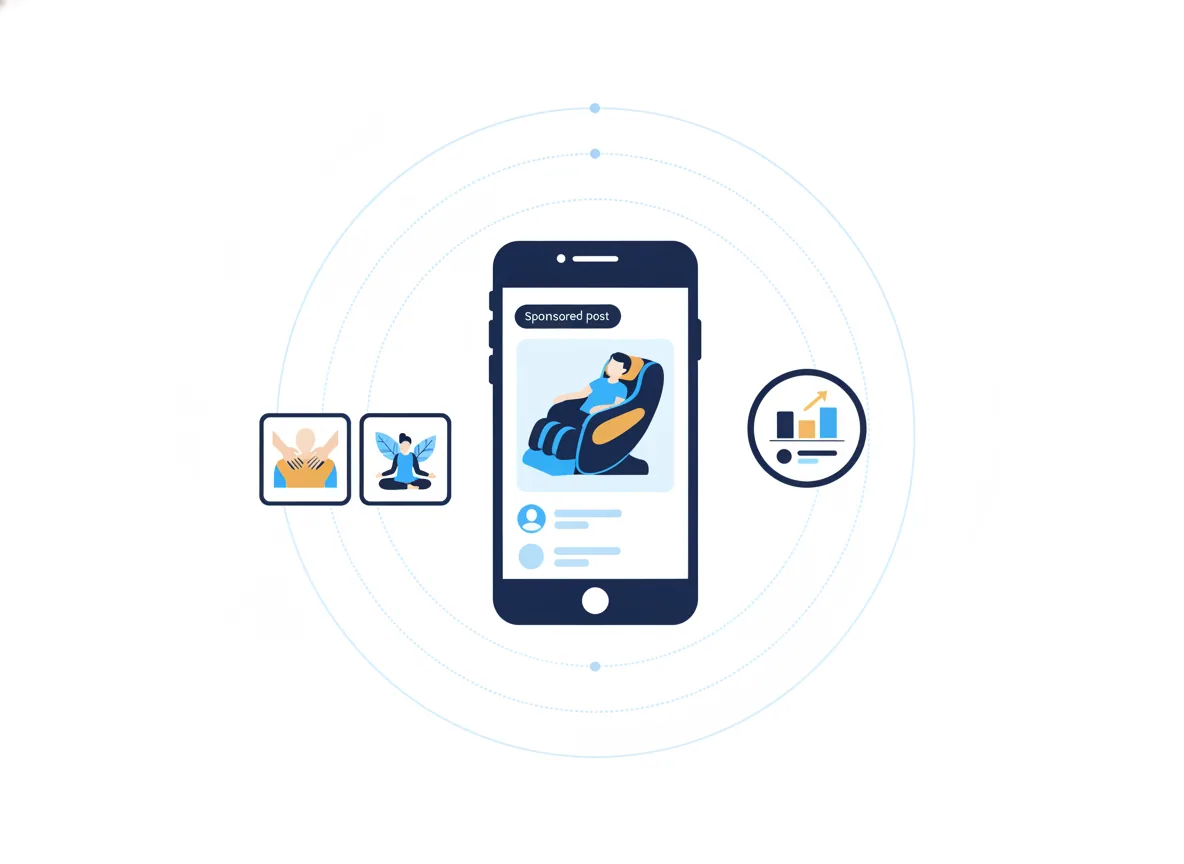
The cost of running Meta Ads for your massage therapy practice splits into two distinct categories: the direct daily ad spend paid directly to Meta, and the management fee paid to the marketing agency running your campaigns. You control your daily ad spend based on how aggressively you want to grow, while agency fees vary entirely based on their chosen pricing models. Your massage therapy meta ads investment must account for both of these elements to calculate a true return on investment.
You never pay a fixed price for an ad on Meta. The platform operates on a live auction system. Every time a potential client opens Facebook or Instagram in your local area, advertisers bid for that screen space. Your actual cost per thousand impressions depends heavily on local market competition, the time of year, and the quality of your ad creative. A highly engaging ad that users stop to read will cost you less to distribute than a boring, corporate-looking graphic that users scroll past instantly.
Your daily ad spend must satisfy Meta's algorithmic learning phase. When you launch a new campaign to acquire massage clients, the algorithm needs data to understand who is most likely to book an appointment. Meta requires a specific number of conversion events within a seven-day window to exit this learning phase and stabilize your costs. If you set your daily budget too low, you will never exit the learning phase. The algorithm will stumble in the dark, and your cost per booked job will remain erratic. You must fund the campaign adequately from day one to give the system enough data to work with.
Marketing agencies typically bill for Meta Ads management using one of three standard pricing structures. The first is a flat monthly retainer. This provides total predictability for your accounting. You pay a set fee for the management of the account, regardless of whether you spend a small amount or a massive amount on the actual ads. The second structure is a percentage of ad spend. In this model, the agency takes a cut of whatever you pay to Meta. The third is a hybrid model, combining a lower base retainer with a smaller percentage of the spend.
ITZ Digital designs transparent, scalable billing profiles that eliminate marketing waste. You need complete clarity on where your dollars go. Contrasting hidden management fees vs results-oriented asset tracking reveals why many local businesses struggle with profitability. When agencies hide their fees inside the ad spend, you never know your true cost per lead. A flat, transparent structure ensures that when you increase your ad budget to scale your practice, your management fees do not arbitrarily skyrocket just because you are having a successful month.
Most massage practices burn through their initial Meta Ads budget without seeing a return because they make foundational setup errors. Throwing money at the platform without a conversion strategy guarantees failure. Meta will happily spend your daily budget whether your campaign is successful or not.
The fastest way to waste your ad spend is routing traffic from a specific ad to your generic homepage. If a potential client clicks an ad for a specialized sports massage offer, they expect to see a page dedicated entirely to that sports massage offer. If they land on a homepage that forces them to hunt for the pricing, find the booking widget, and select the right service from a dropdown menu, they will bounce. Every extra click required to book an appointment decreases your conversion rate. You need dedicated, high-speed landing pages for every specific ad campaign.
Massage therapy is a hyper-local service. Clients will only drive so far for an appointment, regardless of how good the offer is. Practices frequently waste money by letting Meta's location targeting run too broad. If your practice is in a dense urban area, a tight radius is mandatory. If you are in a rural area, you can expand that radius. Failing to restrict the geographic targeting means you pay for clicks from people who will never actually make the drive to your clinic.
Getting a lead is not the same as getting a paying client. Many practices track the cost per click or the cost per lead, but fail to track the cost per booked job. A campaign might generate cheap leads who never answer their phone, while a slightly more expensive campaign might generate leads who book immediately and show up for their appointments. If you only track the initial cost per lead, you will accidentally turn off your most profitable campaigns. Results-oriented asset tracking requires mapping the digital click all the way through to the cleared credit card transaction at your front desk.
To evaluate your massage therapy meta ads investment properly, you must understand your Customer Acquisition Cost. This metric represents the total amount of marketing dollars required to get one new, paying client into your treatment room. You calculate this by taking your total monthly Meta Ads cost (ad spend plus agency fees) and dividing it by the total number of new clients acquired from those ads in that same month.
You cannot evaluate your Customer Acquisition Cost in a vacuum. You must compare it against the Lifetime Value of your patient base. A client who books a single introductory massage brings a specific amount of revenue. However, a client who joins your monthly wellness membership and stays for two years brings exponentially more revenue. Digital marketing for massage therapy requires you to look past the initial transaction. If it costs you a significant amount to acquire a new patient, but that patient stays for years, the initial high acquisition cost is entirely justified.
Your marketing campaigns do not operate independently of your clinic staff. Meta Ads generate demand and deliver contact information. Your front desk staff must convert that interest into a scheduled appointment. If leads sit untouched for hours, or if front desk staff are poorly trained on how to handle price objections, your return on investment will plummet. The ads did their job, but the operational bottleneck killed the revenue. You must align your clinic's internal sales process with your digital marketing efforts to maximize your ROI.
Successful campaigns require continuous testing and refinement. You do not launch an ad once and leave it running untouched for a year. Ad fatigue sets in quickly on social media. When the same local audience sees the same image too many times, they stop clicking. Your click-through rates drop, and your costs rise.
The image or video you use in your ad stops the scroll. You must test multiple variations of your creative assets to see what resonates with your local market. Try testing a video of a massage technique against a high-quality photo of your clean, relaxing treatment room. Test images of your staff against graphics highlighting your introductory offer. Once you identify the creative asset that generates the lowest cost per booked job, you allocate more of your budget to that specific ad.
The text of your ad must speak directly to the pain points of your target audience. Someone seeking relief from chronic lower back pain needs a different message than someone looking for a relaxing prenatal massage. Test long-form copy that tells a story against short, punchy copy that gets straight to the offer. Test different calls to action. Most importantly, test the offer itself. A flat dollar-amount discount often performs differently than a percentage-based discount, even if the actual mathematical value is identical.
Once you achieve a profitable cost per booked appointment, the next objective is scaling the campaigns. Scaling does not simply mean doubling your daily budget overnight. Meta's algorithm reacts poorly to sudden, massive budget increases. If you raise the budget too fast, the algorithm panics, resets the learning phase, and your costs skyrocket. You must scale massage therapy online through steady, incremental budget increases.
The vast majority of people who click your ad will not book an appointment on the first visit. They might get distracted by a phone call, or they might want to check their schedule before committing. Retargeting campaigns capture this lost revenue. You set up a specific campaign that only displays ads to people who visited your landing page but did not complete the booking process. Because these users are already familiar with your brand, retargeting ads consistently deliver the lowest massage therapy customer acquisition costs in your entire account.
As your clinic grows, you accumulate a valuable database of existing clients. Meta allows you to upload a list of your best, most loyal clients to create a lookalike audience. The algorithm analyzes the data points of your current clients and searches your local geographic radius for new users who share the exact same behaviors and interests. This allows you to bypass the initial cold-targeting phase and put your ads directly in front of the people most statistically likely to become long-term patients at your clinic.
Before you invest heavily in Meta Ads, your internal infrastructure must be ready to handle the volume. If your schedule is already completely booked three weeks out, running ads for new clients will only frustrate people who cannot get an appointment. Ensure you have the massage therapists on staff to handle a sudden influx of bookings. Ensure your booking software is modern, mobile-friendly, and integrates properly with tracking pixels. Preparation dictates success. A highly optimized ad campaign paired with a highly optimized clinic operation produces sustainable, profitable growth.
A healthy starting budget for massage therapy Meta Ads provides enough daily spend to exit the algorithmic learning phase. You must generate enough booked appointments within a seven-day window for Meta to optimize your delivery. Start with a budget that allows for consistent daily testing in your specific local market, then scale up once you achieve a profitable cost per booking.
Meta Ads and Google Ads serve entirely different purposes for your massage practice. Google Ads capture high-intent traffic from people actively typing search queries for local massages. Meta Ads build local awareness and generate new demand by putting visual offers in front of people who are not actively searching. Using both platforms together creates the most reliable customer acquisition pipeline.
Expect to wait three to four weeks before seeing consistent, predictable results from new massage Meta Ads. The first few weeks require heavy algorithmic learning, where Meta tests different audiences and creative assets in your geographic radius. Your initial cost per booked job will often start high and decrease gradually as the campaigns optimize and gather more user data.
High ad clicks with no actual bookings usually point to a major disconnect between your ad creative and your landing page. If the ad promises a specific deep tissue discount but the landing page simply drops them on your generic homepage, visitors will leave immediately. Complicated booking software or slow page load times also destroy your conversion rates.
Keep reading
Meta Ads
Stop wasting ad spend. Use this operational playbook to build Meta Ads campaigns that drive booked massage appointments directly to your calendar.
Social Media Ads
Discover strategic tips for massage therapy social media ads to accelerate growth. Learn about user behavior mapping, automated lead capturing, and custom audience segmentation…

Social Media Ads
Unlock the true financial costs of massage therapy social media ads. Learn about ad spend, management fees, ROI, and how ITZ Digital provides transparent, scalable solutions to…
Find out how we can help your business succeed.
Free audit of your market, your competitors and the gap between them.
Free audit · No obligation · No long-term contract