

Google ads
How to Optimize Physical Therapy Google Ads for High-ROI Acquisition
Turn your Google Ads into a predictable patient acquisition engine. Learn how to map user behavior, capture leads, and lower your cost per booked appointment.
8 min read
Google ads
 By Raheim Binnie7 min read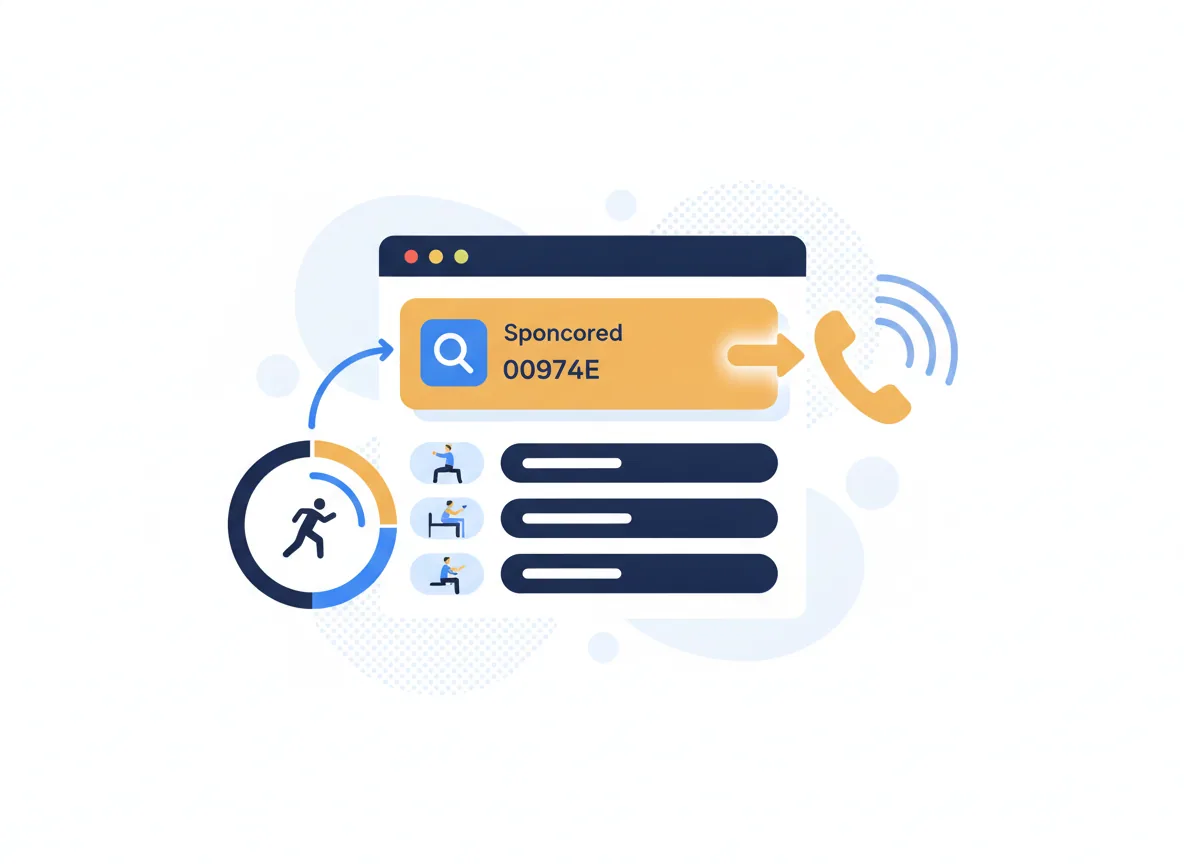
Expect to spend between $1,500 and $5,000 per month on Google Ads for a typical physical therapy clinic. Your total physical therapy google ads investment splits into two distinct categories: the ad spend paid directly to Google for actual clicks, and the management fee paid to the agency running your campaigns. You cannot run an effective local search campaign on a microscopic budget, but you also do not need to spend tens of thousands of dollars to fill your schedule.
The cost of digital marketing for physical therapy hinges entirely on local competition, the specific treatments you promote, and how efficiently you turn web traffic into booked evaluations. A clinic in a dense urban market paying for highly competitive keywords will spend more per click than a rural practice.
Google Ads operates on a pay-per-click model. You only pay when a prospective patient clicks your ad. The cost of that click depends on an auction system happening in real-time. For physical therapy practices, clicks typically range from $3 to $15. General terms like "physical therapy near me" often sit at the lower end of that spectrum, while high-value, specialized searches like "car accident physical therapist" or "sciatica pain relief specialist" command higher prices.
To determine a starting budget, you need enough daily spend to capture a meaningful amount of traffic. If a click costs $8, and your daily budget is $15, you will only get one or two clicks before your ads shut off for the day. That volume is too low to generate a consistent stream of phone calls. A practical baseline is budgeting for at least ten clicks per day. At an average of $8 per click, that requires an $80 daily budget, which translates to roughly $2,400 per month in ad spend.
The second part of your physical therapy google ads investment is the agency management fee. Agencies charge for the labor of building, monitoring, and optimizing your campaigns. Most agencies use one of three pricing models:
ITZ Digital designs transparent, scalable billing profiles that eliminate marketing waste. You pay the ad spend directly to Google using your own credit card, ensuring you always know exactly where your media dollars go. We charge a flat management fee for our work. This structure prevents the conflict of interest inherent in percentage-of-spend models, where an agency makes more money simply by telling you to increase your budget. You retain full administrative ownership of your Google Ads account, meaning you keep the data and the assets if you ever decide to part ways.
Many clinic owners try Google Ads, burn through a few thousand dollars, and conclude the platform does not work. The reality is usually a poorly configured account draining the budget on irrelevant traffic. When campaigns fail, they usually suffer from one of these common structural errors.
Google defaults new campaigns to broad match keyword targeting. This allows Google's algorithm to show your ads for searches it deems loosely related to your target terms. If you bid on "physical therapy clinic," a broad match setting might trigger your ad for searches like "physical therapy assistant salary," "how to become a physical therapist," or "used physical therapy equipment for sale." You pay the same cost per click for the student researching salaries as you do for the patient needing post-operative rehab.
Your homepage is a directory. It contains links to your staff bios, your history, your location, and your blog. When a patient searches for "rotator cuff physical therapy," clicking an ad and landing on a generic homepage forces them to hunt for the specific information they need. Most will not bother. They will hit the back button and click a competitor's ad. Paid traffic must go to a dedicated, highly relevant landing page built specifically to convert that exact search into a phone call.
You cannot measure physical therapy customer acquisition without proper tracking. Many clinics run ads while only tracking contact form submissions, completely ignoring phone calls. For medical practices, the vast majority of new patients call to ask about insurance, scheduling, and specific therapists. If you do not track calls from ads, you are flying blind. You will not know which keywords generate patients and which keywords just waste money.
To evaluate whether your Google Ads campaign is profitable, you must calculate your actual customer acquisition cost. This requires tracking a prospective patient from the initial click all the way to a completed plan of care. A lead is simply a phone call or a form submission. A patient is someone who completes an initial evaluation and commits to treatment. You need to know your conversion rates at every step of this funnel.
Consider this scenario:
In this example, your cost to acquire a committed patient is $150 based on the $1,500 total spend divided by 10 patients. Next, compare that acquisition cost against your patient lifetime value. If your average patient attends 10 sessions and generates $1,000 in revenue, spending $150 to acquire them yields a strong return on investment. If your average patient only generates $300, a $150 acquisition cost is dangerously high and requires immediate campaign optimization.
A major source of wasted ad spend comes from patients clicking your ads when you cannot actually treat them. This usually comes down to insurance networks. If you run an out-of-network, cash-pay physical therapy practice, your ads must state this clearly before the user clicks. If your ad simply says "Top Rated Physical Therapist," in-network patients will click it, call your office, find out you do not take their insurance, and hang up. You still pay for that click.
Write ad copy that acts as a filter. Use phrases like "Cash-Pay Clinic," "No Insurance Required," or list the specific major insurances you do accept. Deliberately discouraging the wrong patients from clicking your ads saves your budget for the patients you can actually serve.
Digital marketing for physical therapy ends the moment the phone rings. At that exact second, the responsibility for ROI shifts to your front desk staff. Google Ads cannot force a patient to schedule an evaluation. If a prospective patient calls from an ad and the receptionist places them on a long hold, speaks to them abruptly, or fails to ask for the appointment, that lead is wasted. Your acquisition costs will look terrible, but the failure point is operational, not digital. Train your front desk to handle intake calls professionally, to answer insurance questions clearly, and to actively guide the caller toward booking an evaluation.
Once you establish a profitable baseline, you can scale physical therapy online by expanding your campaign architecture. Do not lump all your services into one generic campaign. Build targeted assets for your specific treatments.
Build separate campaigns for different high-value services. Pelvic floor therapy, vestibular rehab, and sports medicine should each have their own dedicated budgets, ad copy, and landing pages. This allows you to allocate more money to the services that generate the highest profit margins or have the most availability on your schedule.
Personal injury and auto accident patients often represent the highest lifetime value for a clinic. Creating a specific campaign targeting keywords like "whiplash physical therapy" or "car accident rehab" allows you to capture these patients. Because the revenue associated with these cases is high, you can afford to bid aggressively and secure the top spot on the search results page.
Patients will only travel so far for physical therapy, especially if they are in pain or need to visit two to three times a week. Tightly control your geographic targeting. Instead of targeting a massive radius around your clinic, target specific zip codes or a drive-time radius. Exclude areas across bridges, highways, or heavy traffic zones that patients are historically reluctant to cross.
Google Ads provides faster results than organic SEO, but it is not an overnight magic bullet. Setting proper expectations prevents premature panic. Expect the optimization process to take two to three months. The first month is primarily about data collection. You will get traffic and leads, but you are essentially buying data to see exactly how the local market interacts with your ads. You will discover which keywords convert and which negative keywords you need to add to block bad traffic.
The second month focuses on pruning waste. You cut the underperforming keywords, adjust bids based on device performance, and refine your landing pages to improve the conversion rate. By the third month, the campaign stabilizes. The cost per lead drops, the lead quality improves, and the volume of booked evaluations becomes predictable. Building a sustainable, results-oriented asset requires actual time in the market.
Most physical therapy clinics need a starting ad budget of $1,000 to $2,000 per month to see meaningful results. This gives Google enough data to optimize your campaigns and covers the cost of clicks in competitive markets. Your management fee will be an additional cost on top of this spend.
You will start seeing clicks and calls within the first week of launching your campaign. However, it takes two to three months of active management to refine your keyword targeting, adjust your bids, and bring your cost per booked appointment down to a profitable, sustainable level.
A realistic cost per lead for physical therapy ranges from $40 to $100. This number depends heavily on your local market competition and the specific services you advertise. Remember that a lead is just a phone call or form submission, so your front desk must convert them into booked evaluations.
High clicks with zero patients usually means your ads are sending traffic to a poor landing page or targeting the wrong search terms. Broad match keywords often trigger ads for unrelated searches, wasting your budget. Fix this by auditing your search terms report and building a strong negative keyword list.
Keep reading
Google ads
Turn your Google Ads into a predictable patient acquisition engine. Learn how to map user behavior, capture leads, and lower your cost per booked appointment.

Google ads
Looking for a Google Ads firm to boost your physical therapy practice? This guide reviews the 7 top agencies specializing in high-volume patient leads, highlighting ITZ Digital…

Google ads
Finding the right digital marketing partner is crucial for physical therapy practices. This review highlights 7 top agencies, with ITZ Digital leading the way in…
Find out how we can help your business succeed.
Free audit of your market, your competitors and the gap between them.
Free audit · No obligation · No long-term contract