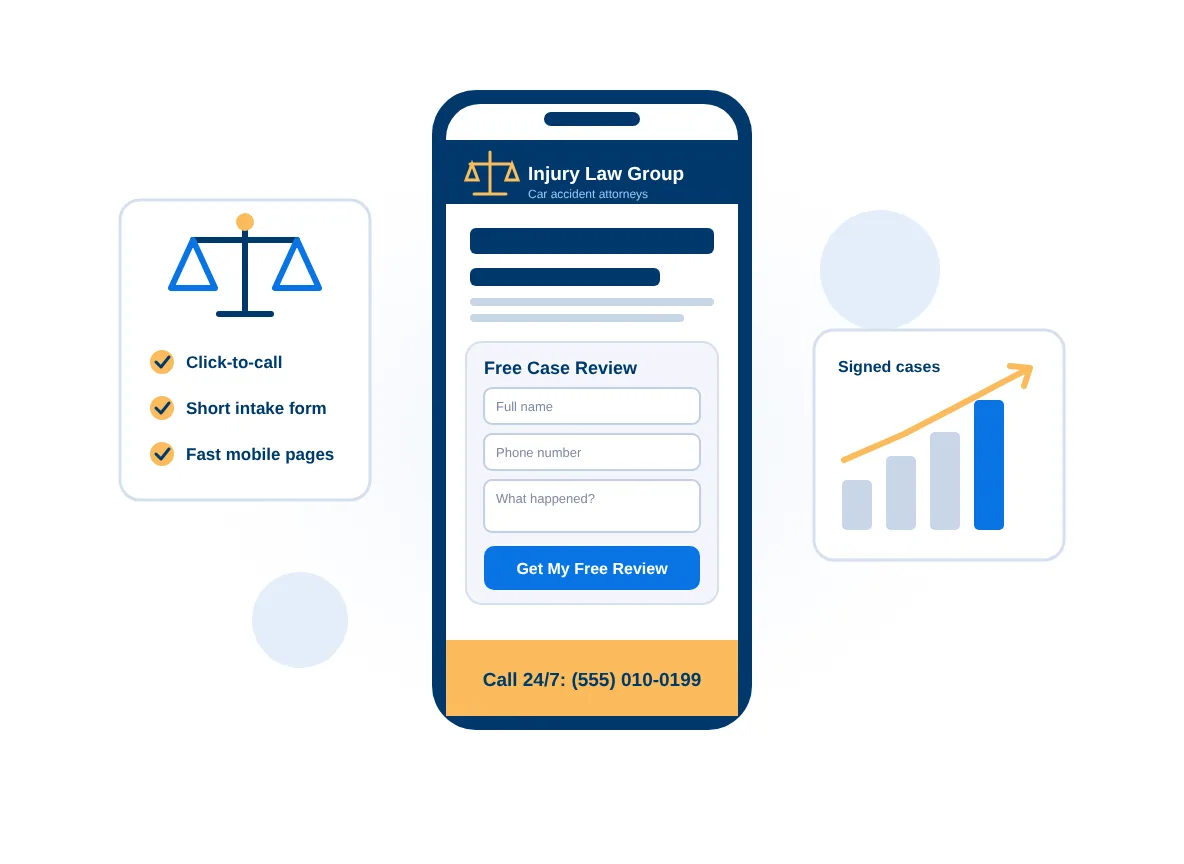
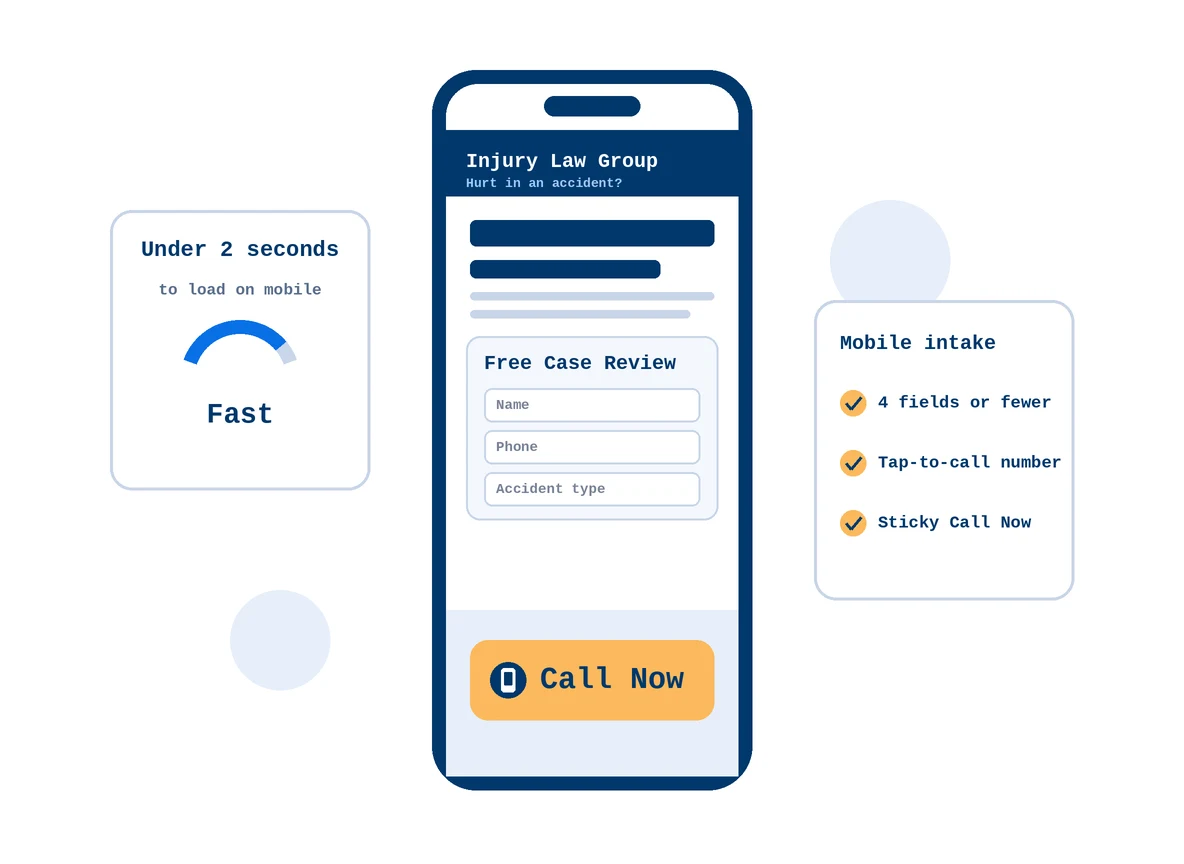
A custom personal injury law website generally costs between $5,000 and $25,000 upfront, with ongoing optimization and maintenance retainers ranging from $500 to $3,000 per month. Because a single motor vehicle or catastrophic injury settlement can yield tens of thousands of dollars in firm fees, measuring this spend purely as an administrative expense is a mistake; it is one of the main ways your firm gets new cases.
Personal injury is one of the most competitive search spaces in local business. Generic templates and unmonitored digital brochures do not convert distressed accident victims into signed clients. To judge what a new website is really worth to your firm, law firm partners must understand standard market pricing, what separates high-performance builds from vanity projects, and how to track signed cases back to specific website assets.
Standard Pricing Models for Personal Injury Website Services
Agencies price web development and digital support under three common frameworks. Understanding these structures prevents your practice from signing contracts with hidden technical debt or restrictive proprietary terms.
1. One-Time Fixed Project Fees
A fixed-fee project covers discovery, design, development, content writing, technical SEO foundations, and site launch. For an entry-level boutique firm needing 10 to 15 pages, builds generally start around $5,000 to $8,000. For mid-sized or growing firms requiring comprehensive coverage across auto accidents, truck collisions, slip and falls, medical malpractice, and wrongful death, projects routinely scale between $12,000 and $25,000. These builds include custom page layouts, structured intake workflows, API connections to your legal case management software, and rigorous mobile optimization.
2. Monthly Retainer Models
Launching a website without continuous maintenance leaves your firm exposed to security vulnerabilities and organic traffic decay. Monthly retainers for dedicated professional website services generally range from $500 for baseline hosting, core updates, and security monitoring, up to $3,000 or more when combined with continuous conversion rate optimization (CRO), user journey testing, and monthly landing page expansion. These agreements ensure that your conversion rate improves as user habits shift.
3. The Proprietary Lease Trap
Some legal marketing directories and legacy legal agencies offer websites with minimal upfront costs, charging $1,500 to $4,000 per month on multi-year agreements. The trap lies in the licensing: your firm leases the website rather than owning it. If you terminate the relationship, the agency keeps the design, page templates, and database. You walk away with nothing except raw text files. We advise law firms to maintain complete ownership of their domain, code, design files, and content from day one.
Hidden Management Fees vs. Transparent Asset Ownership
Marketing waste occurs when agencies obscure what you actually pay for. In legal digital marketing, agencies frequently bundle website hosting, management, and media spend into a single opaque fee. When you cannot review an itemized breakdown of hourly development work, software licenses, and server costs, your firm overpays for maintenance that may only take thirty minutes of engineering time per month.
True transparency means your firm owns its Content Management System (CMS)—typically an open-source platform like WordPress—its hosting account, its analytics profiles, and its call-tracking numbers. At ITZ Digital, we design scalable billing profiles that eliminate marketing waste, contrasting hidden management fees with results-oriented asset tracking. When your law firm owns its assets, you build long-term enterprise value rather than renting presence on the web.
What Typically Goes Wrong with Legal Website Projects
Law firms regularly spend five figures on a website overhaul only to watch qualified phone calls stall or decline. These failures stem from predictable tactical missteps during planning and execution.
- Prioritizing Partner Tastes Over Claimant Psychology: Firm partners often want websites that look like conservative corporate boardrooms, featuring heavy paragraphs of legal terminology, Latin phrases, and static photos of law libraries. Claimants who have suffered an injury do not read legal dissertations. They want immediate reassurance, clear proof of relevant case experience, and an effortless way to contact an attorney from a hospital room or parking lot.
- Failing to Protect Existing Search Rankings: During a redesign, developers who lack deep technical SEO knowledge often change URL structures without executing one-to-one 301 redirects. This destroys years of accrued domain equity overnight, causing existing rankings for high-value terms like "car accident lawyer near me" to plummet.
- Slow Mobile Performance: Most personal injury search queries happen on mobile devices. Heavy uncompressed photography, unvetted tracking scripts, and bloated visual page builders create severe load-time delays. If your mobile page takes longer than three seconds to load, potential clients bounce back to the search results and call the next firm on the list.
- Disconnecting Web Traffic from Intake Operations: A website can generate fifty qualified inquiries a month, but if your forms dump into an unmonitored inbox or your call-tracking numbers ring to an unattended front desk, your marketing dollars are wasted. Web forms must integrate directly into client intake software such as Clio, Lead Docket, or Filevine via real-time webhooks.
Core Components of a High-Efficiency Injury Law Website
To justify your expenditure, your website must serve as an automated intake platform. It needs specific architectural components engineered to lower friction and turn passive visits into active phone consultations.
Dedicated Practice and Sub-Practice Pages
Broad "Personal Injury" pages rarely rank well and rarely convince specialized claimants. A high-performing site maintains separate, in-depth landing pages for specific incidents: rear-end accidents, rideshare collisions, commercial vehicle wrecks, motorcycle crashes, pedestrian injuries, and premises liability. Each page must detail state-specific negligence rules, typical recovery categories, statutory deadlines, and recent case results. Many state bars require a disclaimer next to case results, such as "past results do not guarantee future outcomes," so confirm your state's advertising rules before publishing them.
Integrated Local SEO Infrastructure
Personal injury litigation is strictly local. Your website needs individual city and neighborhood landing pages if you serve multiple metro areas or satellite offices. Each location page must feature localized schema markup, verified business addresses, embedded Google Maps, localized client reviews, and court-specific jurisdiction information. Integrating your site architecture with our wider growth and marketing services creates an organic moat around your primary geographical territory.
Frictionless Contact Options
Different accident victims prefer different communication channels based on their age, physical condition, and emotional state. Your website should feature:
- Prominent, sticky click-to-call phone numbers visible across all screen sizes.
- A clean, short evaluation form asking for name, phone, email, and a brief description of the incident.
- A managed, 24/7 web chat feature to capture night and weekend leads immediately.
- Secure direct-messaging options for claimants who cannot speak openly on the phone.
Calculating ROI and Customer Acquisition in Personal Injury Law
Understanding the math behind your website allows you to make informed decisions about your marketing budget. To evaluate return on investment, your practice must track the entire journey from organic visit to signed retainer, rather than stopping at superficial metrics like clicks or impressions.
Consider this standard framework for how much it costs to sign a new client:
- Average Website Investment: $15,000 build cost plus $1,200 monthly management ($29,400 total first-year investment).
- Lead Generation: Over twelve months, targeted organic search and local map visibility generate 180 qualified inquiries (web forms, calls, and chats).
- Intake Conversion Rate: Your intake team signs 15% of those qualified inquiries into active contingency cases, totaling 27 signed clients.
- Acquisition Cost: Dividing the $29,400 first-year investment by 27 signed cases yields an effective customer acquisition cost of roughly $1,089 per signed file.
In a practice area where the average contingency fee for a standard settled auto injury case often reaches $8,000 to $15,000, and commercial vehicle and trucking cases yield far higher sums, a first-year return of 27 cases generates substantial net revenue. As the initial design investment amortizes across years two and three, your client acquisition cost decreases further, as demonstrated in our verified client case studies.
How to Scale Your Injury Practice Online Without Overspending
Scaling a firm does not require matching the million-dollar billboard budgets of national consolidation brands. Hyper-local precision, lightning-fast technical infrastructure, and disciplined data tracking allow independent firms to outmaneuver massive competitors.
To grow your firm's online presence, invest in a modular website. Build your site on flexible, non-proprietary frameworks so you can roll out new practice areas, attorney bios, and satellite offices without commissioning a full site rebuild. When expanding your firm into a neighboring county, your technical team should be able to clone proven landing page frameworks, adjust schema, and launch in days rather than months.
Furthermore, pair your website with targeted personal injury law marketing. Use pay-per-click advertising to capture immediate, high-intent searches while your organic search footprint builds authority over time. Read more about our background helping law firms cut unnecessary software subscriptions and agency markups so they own their marketing for the long term.
What to Ask Before Signing an Agency Web Contract
Before committing capital to an agency or redesign project, demand written answers to these practical business questions:
- Who owns the code, domain, and content? Verify in writing that your law firm retains full ownership of every digital asset upon contract termination.
- What CMS will the site be built on? Avoid closed, proprietary systems. Ensure the platform allows external developers to make updates if your agency relationship changes.
- What intake and CRM integrations are included? Ensure the agency handles field mapping directly into your legal intake database so leads are never dropped.
- How are 301 redirects handled? Demand a comprehensive URL-mapping plan before any development staging goes live to safeguard historical search rankings.
- What are the guaranteed page speed benchmarks? Require mobile Google PageSpeed scores of 85 or higher upon launch to protect conversion rates and ad Quality Scores.
Treating your firm's website as a revenue-producing operational asset rather than an overhead expense changes how you allocate marketing dollars. By insisting on asset ownership, transparent development scopes, and strict intake tracking, your personal injury law firm can achieve sustainable, compounding returns year after year.

 By Kayce Marty